

Table of contents
- Privacy Policy
- Scope
- Legal bases
- Contact details of the data protection controller
- Storage Period
- Rights in accordance with the General Data Protection Regulation
- Data transfer to third countries
- Security of data processing operations
- Communications
- Cookies
- Web hosting
- Web Analytics
- Facebook Pixel Privacy Policy
- Google Analytics Privacy Policy
- Google Tag Manager Privacy Policy
- Email-Marketing
- Online Marketing
- Google Ads (Google AdWords) Conversion Tracking Privacy Policy
- Content Delivery Networks
- jQuery CDN Privacy Policy
- Cookie Consent Management Platform
- Payment providers
- Klarna Checkout Privacy Policy
- Stripe Privacy Policy
- Sofortüberweisung Privacy Policy
- Social Media
- Facebook Privacy Policy
- Instagram Privacy Policy
- YouTube Privacy Policy
- Google Maps Privacy Policy
- Google Fonts Privacy Policy
- Font Awesome Privacy Policy
- Google reCAPTCHA Privacy Policy
- WooCommerce Privacy Policy
- Cloudflare Privacy Policy
Privacy Policy
We have written this privacy policy (version 23.09.2021-111836018) in order to explain to you, in accordance with the provisions of the General Data Protection Regulation (EU) 2016/679 and applicable national laws, which personal data (data for short) we as the controller – and the processors commissioned by us (e.g. providers) – process, will process in the future and what legal options you have. The terms used are to be considered as gender-neutral.
In short: We provide you with comprehensive information about any personal data we process about you.
Privacy policies usually sound very technical and use legal terminology. However, this privacy policy is intended to describe the most important things to you as simply and transparently as possible. So long as it aids transparency, technical terms are explained in a reader-friendly manner, links to further information are provided and graphics are used. We are thus informing in clear and simple language that we only process personal data in the context of our business activities if there is a legal basis for it. This is certainly not possible with brief, unclear and legal-technical statements, as is often standard on the Internet when it comes to data protection. I hope you find the following explanations interesting and informative. Maybe you will also find some information that you have not been familiar with.
If you still have questions, we would like to ask you to contact the responsible body named below or in the imprint, to follow the existing links and to look at further information on third-party sites. You can of course also find our contact details in the imprint.
Scope
This privacy policy applies to all personal data processed by our company and to all personal data processed by companies commissioned by us (processors). With the term personal data, we refer to information within the meaning of Article 4 No. 1 GDPR, such as the name, email address and postal address of a person. The processing of personal data ensures that we can offer and invoice our services and products, be it online or offline. The scope of this privacy policy includes:
- all online presences (websites, online shops) that we operate
- Social media presences and email communication
- mobile apps for smartphones and other devices
In short: This privacy policy applies to all areas in which personal data is processed in a structured manner by the company via the channels mentioned. Should we enter into legal relations with you outside of these channels, we will inform you separately if necessary.
Legal bases
In the following privacy policy, we provide you with transparent information on the legal principles and regulations, i.e. the legal bases of the General Data Protection Regulation, which enable us to process personal data.
Whenever EU law is concerned, we refer to REGULATION (EU) 2016/679 OF THE EUROPEAN PARLIAMENT AND OF THE COUNCIL of April 27, 2016. You can of course access the General Data Protection Regulation of the EU online at EUR-Lex, the gateway to EU law, at https://eur-lex.europa.eu/legal-content/EN/TXT/?uri=celex%3A32016R0679.
We only process your data if at least one of the following conditions applies:
- Consent (Article 6 Paragraph 1 lit. a GDPR): You have given us your consent to process data for a specific purpose. An example would be the storage of data you entered into a contact form.
- Contract (Article 6 Paragraph 1 lit. b GDPR): We process your data in order to fulfill a contract or pre-contractual obligations with you. For example, if we conclude a sales contract with you, we need personal information in advance.
- Legal obligation (Article 6 Paragraph 1 lit. c GDPR): If we are subject to a legal obligation, we will process your data. For example, we are legally required to keep invoices for our bookkeeping. These usually contain personal data.
- Legitimate interests (Article 6 Paragraph 1 lit. f GDPR): In the case of legitimate interests that do not restrict your basic rights, we reserve the right to process personal data. For example, we have to process certain data in order to be able to operate our website securely and economically. Therefore, the processing is a legitimate interest.
Other conditions such as making recordings in the interest of the public, the exercise of official authority as well as the protection of vital interests do not usually occur with us. Should such a legal basis be relevant, it will be disclosed in the appropriate place.
In addition to the EU regulation, national laws also apply:
- In Austria this is the Austrian Data Protection Act (Datenschutzgesetz), in short DSG.
- In Germany this is the Federal Data Protection Act (Bundesdatenschutzgesetz), in short BDSG.
Should other regional or national laws apply, we will inform you about them in the following sections.
Contact details of the data protection controller
If you have any questions about data protection, you will find the contact details of the responsible person or controller below:
FBT Fine Ballistic Tools GmbH
Gewerbestraße 1167
8962 Gröbming
AUSTRIA
Authorised to represent:
Email: info@verex-tactical.com
Phone: +43 676 481 7980
Company details: https://www.verex-tactical.com
Storage Period
It is a general criterion for us to store personal data only for as long as is absolutely necessary for the provision of our services and products. This means that we delete personal data as soon as any reason for the data processing no longer exists. In some cases, we are legally obliged to keep certain data stored even after the original purpose no longer exists, such as for accounting purposes.
If you want your data to be deleted or if you want to revoke your consent to data processing, the data will be deleted as soon as possible, provided there is no obligation to continue its storage.
We will inform you below about the specific duration of the respective data processing, provided we have further information.
Rights in accordance with the General Data Protection Regulation
You are granted the following rights in accordance with the provisions of the GDPR (General Data Protection Regulation) and the Austrian Data Protection Act (DSG):
- right to rectification (article 16 GDPR)
- right to erasure (“right to be forgotten“) (article 17 GDPR)
- right to restrict processing (article 18 GDPR)
- righ to notification – notification obligation regarding rectification or erasure of personal data or restriction of processing (article 19 GDPR)
- right to data portability (article 20 GDPR)
- Right to object (article 21 GDPR)
- right not to be subject to a decision based solely on automated processing – including profiling – (article 22 GDPR)
If you think that the processing of your data violates the data protection law, or that your data protection rights have been infringed in any other way, you can lodge a complaint with your respective regulatory authority. For Austria this is the data protection authority, whose website you can access at https://www.data-protection-authority.gv.at/.
Austria Data protection authority
Manager: Mag. Dr. Andrea Jelinek
Address: Barichgasse 40-42, 1030 Wien
Phone number.: +43 1 52 152-0
E-mail address: dsb@dsb.gv.at
Website: https://www.dsb.gv.at/
Data transfer to third countries
We only transfer or process data to countries outside the EU (third countries) if you consent to this processing, if this is required by law or if it is contractually necessary. In any case, we generally only do so to the permitted extent. In most cases, your consent is the most important reason for data being processed in third countries. When personal data is being processed in third countries such as the USA, where many software manufacturers offer their services and have their servers located, your personal data may be processed and stored in unexpected ways.
We want to expressly point out, that according to the European Court of Justice, there is currently no adequate level of protection for data transfer to the USA. Data processing by US services (such as Google Analytics) may result in data processing and retention without the data having undergone anonymisation processes. Furthermore, US government authorities may be able to access individual data. The collected data may also get linked to data from other services of the same provider, should you have a user account with the respective provider. We try to use server locations within the EU, whenever this is offered and possible.
We will provide you with more details about data transfer to third countries in the appropriate sections of this privacy policy, whenever applicable.
Security of data processing operations
In order to protect personal data, we have implemented both technical and organisational measures. We encrypt or pseudonymise personal data wherever this is possible. Thus, we make it as difficult as we can for third parties to extract personal information from our data.
Article 25 of the GDPR refers to “data protection by technical design and by data protection-friendly default” which means that both software (e.g. forms) and hardware (e.g. access to server rooms) appropriate safeguards and security measures shall always be placed. If applicable, we will outline the specific measures below.
TLS encryption with https
The terms TLS, encryption and https sound very technical, which they are indeed. We use HTTPS (Hypertext Transfer Protocol Secure) to securely transfer data on the Internet.
This means that the entire transmission of all data from your browser to our web server is secured – nobody can “listen in”.
We have thus introduced an additional layer of security and meet privacy requirements through technology design Article 25 Section 1 GDPR). With the use of TLS (Transport Layer Security), which is an encryption protocol for safe data transfer on the internet, we can ensure the protection of confidential information.
You can recognise the use of this safeguarding tool by the little lock-symbol  , which is situated in your browser’s top left corner in the left of the internet address (e.g. examplepage.uk), as well as by the display of the letters https (instead of http) as a part of our web address.
If you want to know more about encryption, we recommend you to do a Google search for “Hypertext Transfer Protocol Secure wiki” to find good links to further information.
Communications
| Communications Overview 👥 Affected parties: Anyone who communicates with us via phone, email or online form 📓 Processed data: e. g. telephone number, name, email address or data entered in forms. You can find more details on this under the respective form of contact 🤝 Purpose: handling communication with customers, business partners, etc. 📅 Storage duration: for the duration of the business case and the legal requirements ⚖️ Legal basis: Article 6 (1) (a) GDPR (consent), Article 6 (1) (b) GDPR (contract), Article 6 (1) (f) GDPR (legitimate interests) |
If you contact us and communicate with us via phone, email or online form, your personal data may be processed.
The data will be processed for handling and processing your request and for the related business transaction. The data is stored for this period of time or for as long as is legally required.
Affected persons
The above-mentioned processes affect all those who seek contact with us via the communication channels we provide.
Telephone
When you call us, the call data is stored in a pseudonymised form on the respective terminal device, as well as by the telecommunications provider that is being used. In addition, data such as your name and telephone number may be sent via email and stored for answering your inquiries. The data will be erased as soon as the business case has ended and the legal requirements allow for its erasure.
If you communicate with us via email, your data is stored on the respective terminal device (computer, laptop, smartphone, …) as well as on the email server. The data will be deleted as soon as the business case has ended and the legal requirements allow for its erasure.
Online forms
If you communicate with us using an online form, your data is stored on our web server and, if necessary, forwarded to our email address. The data will be erased as soon as the business case has ended and the legal requirements allow for its erasure.
Legal bases
Data processing is based on the following legal bases:
- Art. 6 para. 1 lit. a GDPR (consent): You give us your consent to store your data and to continue to use it for the purposes of the business case;
- Art. 6 para. 1 lit. b GDPR (contract): For the performance of a contract with you or a processor such as a telephone provider, or if we have to process the data for pre-contractual activities, such as preparing an offer;
- Art. 6 para. 1 lit. f GDPR (legitimate interests): We want to conduct our customer inquiries and business communication in a professional manner. Thus, certain technical facilities such email programs, Exchange servers and mobile network operators are necessary to efficiently operate our communications.
Cookies
| Cookies Overview 👥 Affected parties: visitors to the website 🤝 Purpose: depending on the respective cookie. You can find out more details below or from the software manufacturer that sets the cookie. 📓 Processed data: Depending on the cookie used. More details can be found below or from the manufacturer of the software that sets the cookie. 📅 Storage duration: can vary from hours to years, depending on the respective cookie ⚖️ Legal basis: Art. 6 para. 1 lit. a GDPR (consent), Art. 6 para. 1 lit. f GDPR (legitimate interests) |
What are cookies?
Our website uses HTTP-cookies to store user-specific data.
In the following we explain what cookies are and why they are used, so that you can better understand the following privacy policy.
Whenever you surf the Internet, you are using a browser. Common browsers are for example, Chrome, Safari, Firefox, Internet Explorer and Microsoft Edge. Most websites store small text-files in your browser. These files are called cookies.
It is important to note that cookies are very useful little helpers. Almost every website uses cookies. More precisely, these are HTTP cookies, as there are also other cookies for other uses. HTTP cookies are small files that our website stores on your computer. These cookie files are automatically placed into the cookie-folder, which is the “brain” of your browser. A cookie consists of a name and a value. Moreover, to define a cookie, one or multiple attributes must be specified.
Cookies store certain user data about you, such as language or personal page settings. When you re-open our website to visit again, your browser submits these “user-related” information back to our site. Thanks to cookies, our website knows who you are and offers you the settings you are familiar to. In some browsers, each cookie has its own file, while in others, such as Firefox, all cookies are stored in one single file.
The following graphic shows a possible interaction between a web browser such as Chrome and the web server. The web browser requests a website and receives a cookie back from the server. The browser then uses this again as soon as another page is requested.
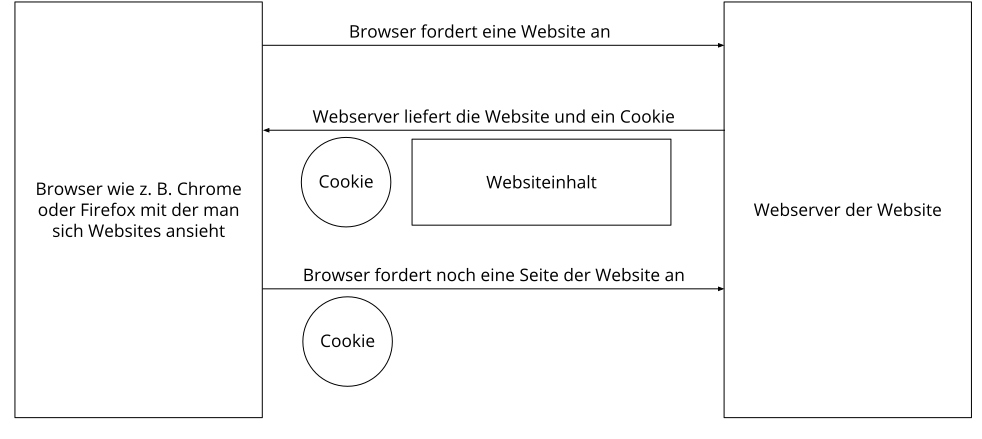
There are both first-party cookies and third-party cookies. First-party cookies are created directly by our site, while third-party cookies are created by partner-websites (e.g. Google Analytics). Each cookie must be evaluated individually, as each cookie stores different data. The expiry time of a cookie also varies from a few minutes to a few years. Cookies are not software programs and do not contain viruses, trojans or other malware. Cookies also cannot access your PC’s information.
This is an example of how cookie-files can look:
Name: _ga
Value: GA1.2.1326744211.152111836018-9
Purpose: Differentiation between website visitors
Expiry date: after 2 years
A browser should support these minimum sizes:
- At least 4096 bytes per cookie
- At least 50 cookies per domain
- At least 3000 cookies in total
Which types of cookies are there?
The exact cookies that we use, depend on the used services, which will be outlined in the following sections of this privacy policy. Firstly, we will briefly focus on the different types of HTTP-cookies.
There are 4 different types of cookies:
Essential cookies
These cookies are necessary to ensure the basic functions of a website. They are needed when a user for example puts a product into their shopping cart, then continues surfing on different websites and comes back later in order to proceed to the checkout. These cookies ensure the shopping cart does not get deleted, even if the user closes their browser window.
Purposive cookies
These cookies collect information about user behaviour and whether the user receives any error messages. Furthermore, these cookies record the website’s loading time as well as its behaviour in different browsers.
Target-orientated cookies
These cookies ensure better user-friendliness. Thus, information such as previously entered locations, fonts sizes or data in forms stay stored.
Advertising cookies
These cookies are also known as targeting cookies. They serve the purpose of delivering customised advertisements to the user. This can be very practical, but also rather annoying.
Upon your first visit to a website you are usually asked which of these cookie-types you want to accept. Furthermore, this decision will of course also be stored in a cookie.
If you want to learn more about cookies and do not mind technical documentation, we recommend https://tools.ietf.org/html/rfc6265, the Request for Comments of the Internet Engineering Task Force (IETF) called “HTTP State Management Mechanism”.
Purpose of processing via cookies
The purpose ultimately depends on the respective cookie. You can find out more details below or from the software manufacturer that sets the cookie.
Which data are processed?
Cookies are little helpers for a wide variety of tasks. Unfortunately, it is not possible to tell which data is generally stored in cookies, but in the privacy policy below we will inform you on what data is processed or stored.
Storage period of cookies
The storage period depends on the respective cookie and is further specified below. Some cookies are erased after less than an hour, while others can remain on a computer for several years.
You can also influence the storage duration yourself. You can manually erase all cookies at any time in your browser (also see “Right of objection” below). Furthermore, the latest instance cookies based on consent will be erased is after you withdraw your consent. The legality of storage will remain unaffected until then.
Right of objection – how can I erase cookies?
You can decide for yourself how and whether you want to use cookies. Regardless of which service or website the cookies originate from, you always have the option of erasing, deactivating or only partially accepting cookies. You can for example block third-party cookies but allow all other cookies.
If you want to find out which cookies have been stored in your browser, or if you want to change or erase cookie settings, you can find this option in your browser settings:
Chrome: Clear, enable and manage cookies in Chrome
Safari: Manage cookies and website data in Safari
Firefox: Clear cookies and site data in Firefox
Internet Explorer: Delete and manage cookies
Microsoft Edge: Delete cookies in Microsoft Edge
If you generally do not want cookies, you can set up your browser in a way to notify you whenever a cookie is about to be set. This gives you the opportunity to manually decide to either permit or deny the placement of every single cookie. This procedure varies depending on the browser. Therefore, it might be best for you to search for the instructions in Google. If you are using Chrome, you could for example put the search term “delete cookies Chrome” or “deactivate cookies Chrome” into Google.
Legal basis
The so-called “cookie directive” has existed since 2009. It states that the storage of cookies requires your consent (Article 6 Paragraph 1 lit. a GDPR). Within countries of the EU, however, the reactions to these guidelines still vary greatly. In Austria, however, this directive was implemented in Section 96 (3) of the Telecommunications Act (TKG). In Germany, the cookie guidelines have not been implemented as national law. Instead, this guideline was largely implemented in Section 15 (3) of the Telemedia Act (TMG).
For absolutely necessary cookies, even if no consent has been given, there are legitimate interests (Article 6 (1) (f) GDPR), which in most cases are of an economic nature. We want to offer our visitors a pleasant user experience on our website. For this, certain cookies often are absolutely necessary.
This is exclusively done with your consent, unless absolutely necessary cookies are used. The legal basis for this is Article 6 (1) (a) of the GDPR.
In the following sections you will find more detail on the use of cookies, provided the used software does use cookies.
Web hosting
| Web hosting Overview 👥 Affected parties: visitors to the website 🤝 Purpose: professional hosting of the website and security of operations 📓 Processed data: IP address, time of website visit, browser used and other data. You can find more details on this below or at the respective web hosting provider. 📅 Storage period: dependent on the respective provider, but usually 2 weeks ⚖️ Legal basis: Art. 6 para. 1 lit. f GDPR (legitimate interests) |
What is web hosting?
Every time you visit a website nowadays, certain information – including personal data – is automatically created and stored, including on this website. This data should be processed as sparingly as possible, and only with good reason. By website, we mean the entirety of all websites on your domain, i.e. everything from the homepage to the very last subpage (like this one here). By domain we mean example.uk or examplepage.com.
When you want to view a website on a screen, you use a program called a web browser. You probably know the names of some web browsers: Google Chrome, Microsoft Edge, Mozilla Firefox, and Apple Safari.
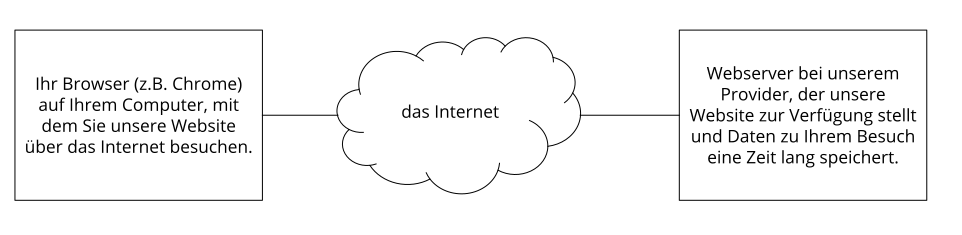
The web browser has to connect to another computer which stores the website’s code: the web server. Operating a web server is complicated and time-consuming, which is why this is usually done by professional providers. They offer web hosting and thus ensure the reliable and flawless storage of website data.
Whenever the browser on your computer establishes a connection (desktop, laptop, smartphone) and whenever data is being transferred to and from the web server, personal data may be processed. After all, your computer stores data, and the web server also has to retain the data for a period of time in order to ensure it can operate properly.
Illustration:
Why do we process personal data?
The purposes of data processing are:
- Professional hosting of the website and operational security
- To maintain the operational as well as IT security
- Anonymous evaluation of access patterns to improve our offer, and if necessary, for prosecution or the pursuit of claims.li>
Which data are processed?
Even while you are visiting our website, our web server, that is the computer on which this website is saved, usually automatically saves data such as
- the full address (URL) of the accessed website (e. g. https://www.examplepage.uk/examplesubpage.html?tid=111836018)
- browser and browser version (e.g. Chrome 87)
- the operating system used (e.g. Windows 10)
- the address (URL) of the previously visited page (referrer URL) (e. g. https://www.examplepage.uk/icamefromhere.html/)
- the host name and the IP address of the device from the website is being accessed from (e.g. COMPUTERNAME and 194.23.43.121)
- date and time
- in so-called web server log files
How long is the data stored?
Generally, the data mentioned above are stored for two weeks and are then automatically deleted. We do not pass these data on to others, but we cannot rule out the possibility that this data may be viewed by the authorities in the event of illegal conduct.
In short: Your visit is logged by our provider (company that runs our website on special computers (servers)), but we do not pass on your data without your consent!
Legal basis
The lawfulness of processing personal data in the context of web hosting is justified in Art. 6 para. 1 lit. f GDPR (safeguarding of legitimate interests), as the use of professional hosting with a provider is necessary to present the company in a safe and user-friendly manner on the internet, as well as to have the ability to track any attacks and claims, if necessary.
Web Analytics
| Web Analytics Privacy Policy Overview 👥 Affected parties: visitors to the website 🤝 Purpose: Evaluation of visitor information to optimise the website. 📓 Processed data: Access statistics that contain data such as access location, device data, access duration and time, navigation behaviour, click behaviour and IP addresses. You can find more details on this from the respective web analytics tool directly. 📅 Storage period: depending on the respective web analytics tool used ⚖️ Legal basis: Art. 6 para. 1 lit. a GDPR (consent), Art. 6 para. 1 lit. f GDPR (legitimate interests) |
What is Web Analytics?
We use software on our website, which is known as web analytics, in order to evaluate website visitor behaviour. Thus, data is collected, which the analytic tool provider (also called tracking tool) stores, manages and processes. Analyses of user behaviour on our website are created with this data, which we as the website operator receive. Most tools also offer various testing options. These enable us, to for example test which offers or content our visitors prefer. For this, we may show you two different offers for a limited period of time. After the test (a so-called A/B test) we know which product or content our website visitors find more interesting. For such testing as well as for various other analyses, user profiles are created and the respective data is stored in cookies.
Why do we run Web Analytics?
We have a clear goal in mind when it comes to our website: we want to offer our industry’s best website on the market. Therefore, we want to give you both, the best and most interesting offer as well as comfort when you visit our website. With web analysis tools, we can observe the behaviour of our website visitors, and then improve our website accordingly for you and for us. For example, we can see the average age of our visitors, where they come from, the times our website gets visited the most, and which content or products are particularly popular. All this information helps us to optimise our website and adapt it to your needs, interests and wishes.
Which data are processed?
The exact data that is stored depends on the analysis tools that are being used. But generally, data such as the content you view on our website are stored, as well as e. g. which buttons or links you click, when you open a page, which browser you use, which device (PC, tablet, smartphone, etc.) you visit the website with, or which computer system you use. If you have agreed that location data may also be collected, this data may also be processed by the provider of the web analysis tool.
Moreover, your IP address is also stored. According to the General Data Protection Regulation (GDPR), IP addresses are personal data. However, your IP address is usually stored in a pseudonymised form (i.e. in an unrecognisable and abbreviated form). No directly linkable data such as your name, age, address or email address are stored for testing purposes, web analyses and web optimisations. If this data is collected, it is retained in a pseudonymised form. Therefore, it cannot be used to identify you as a person.
The following example shows Google Analytics’ functionality as an example for client-based web tracking with JavaScript code.
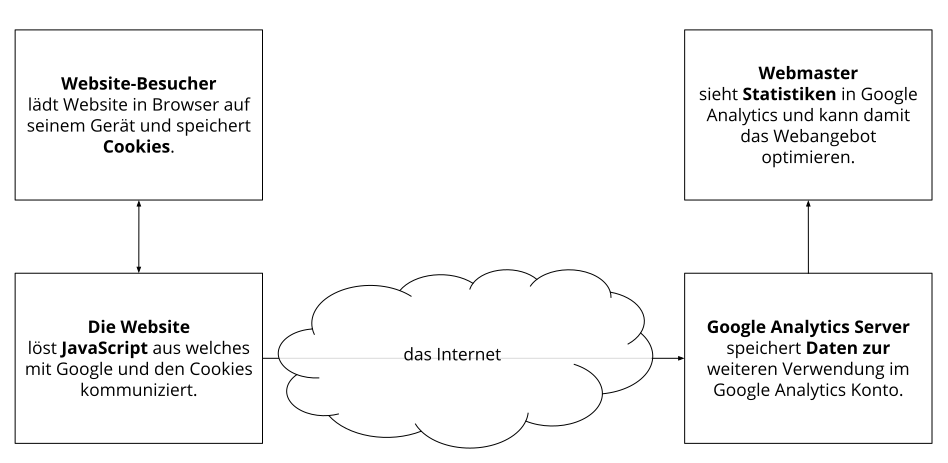
The storage period of the respective data always depends on the provider. Some cookies only retain data for a few minutes or until you leave the website, while other cookies can store data for several years.
Duration of data processing
If we have any further information on the duration of data processing, you will find it below. We generally only process personal data for as long as is absolutely necessary to provide products and services. The storage period may be extended if it is required by law, such as for accounting purposes for example for accounting.
Right to object
You also have the option and the right to revoke your consent to the use of cookies or third-party providers at any time. This works either via our cookie management tool or via other opt-out functions. For example, you can also prevent data processing by cookies by managing, deactivating or erasing cookies in your browser.
Legal basis
The use of Web Analytics requires your consent, which we obtained with our cookie popup. According to Art. 6 para. 1 lit. a of the GDPR (consent), this consent represents the legal basis for the processing of personal data, such as by collection through Web Analytics tools.
In addition to consent, we have a legitimate interest in analysing the behaviour of website visitors, which enables us to technically and economically improve our offer. With Web Analytics, we can recognise website errors, identify attacks and improve profitability. The legal basis for this is Art. 6 para. 1 lit. f of the GDPR (legitimate interests). Nevertheless, we only use these tools if you have given your consent.
Since Web Analytics tools use cookies, we recommend you to read our privacy policy on cookies. If you want to find out which of your data are stored and processed, you should read the privacy policies of the respective tools.
If available, information on special Web Analytics tools can be found in the following sections.
Google Optimize Privacy Policy
On our website we use Google Optimize, which is a web optimisation tool. The provider of this service is the American company Google Inc. The responsible entity for the European region is the Irish company Google Ireland Limited (Gordon House, Barrow Street Dublin 4, Irland).
Google also processes data in the USA, among other countries. We would like to note, that according to the European Court of Justice, there is currently no adequate level of protection for data transfers to the USA. This can be associated with various risks to the legality and security of data processing.
Google uses standard contractual clauses approved by the EU Commission as basis for data processing by recipients based in third countries (outside the European Union, Iceland, Liechtenstein, Norway and especially in the USA) or data transfer there (= Art. 46, paragraphs 2 and 3 of the GDPR). These clauses oblige Google to comply with the EU‘s level of data protection when processing relevant data outside the EU. These clauses are based on an implementing order by the EU Commission. You can find the order and the clauses here: https://ec.europa.eu/commission/presscorner/detail/en/ip_21_2847
You can find out more about Googles’ data processing in their privacy policy at https://policies.google.com/privacy?hl=en-US.
Mouseflow privacy policy
On our website we use Mouseflow, an analysis and tracking software. The provider of this service is the Denish company Mouseflow ApS, Flaesketorvet 68, 1711 Kopenhagen, Denmark. You can find out more on the data that are being processed when using Mouseflow, in their Privacy Policy at https://mouseflow.com/de/privacy/.
Facebook Pixel Privacy Policy
We use Facebook’s Facebook pixel on our website. For that, we have implemented a code on our website. The Facebook pixel is a segment of a JavaScript code, which, in case you came to our website via Facebook ads, loads an array or functions that enable Facebook to track your user actions. For example, if you buy a product on our website, the Facebook pixel is triggered and stores your actions on our website in one or more cookies. These cookies enable Facebook to match your user data (customer data such as IP address, user ID) with the data of your Facebook account. After that, Facebook deletes your data again. The collected data is anonymous as well as inaccessible and can only be used for ad placement purposes. If you are a Facebook user and you are logged in, your visit to our website is automatically assigned to your Facebook user account.
We exclusively want to show our products or services to persons, who are interested in them. With the aid of the Facebook pixel, our advertising measures can get better adjusted to your wishes and interests. Therefore, Facebook users get to see suitable advertisement (if they allowed personalised advertisement). Moreover, Facebook uses the collected data for analytical purposes and for its own advertisements.
In the following we will show you the cookies, which were set on a test page with the Facebook pixel integrated to it. Please consider that these cookies are only examples. Depending on the interaction that is made on our website, different cookies are set.
Name: _fbp
Value: fb.1.1568287647279.257405483-6111836018-7
Purpose: Facebook uses this cookie to display advertising products.
Expiration date: after 3 months
Name: fr
Value: 0aPf312HOS5Pboo2r..Bdeiuf…1.0.Bdeiuf.
Purpose: This cookie is used for Facebook pixels to function properly.
Expiration date: after 3 months
Name: comment_author_50ae8267e2bdf1253ec1a5769f48e062111836018-3
Value: Name of the author
Purpose: This cookie saves the text and name of a user who e.g. leaves a comment.
Expiration date: after 12 months
Name: comment_author_url_50ae8267e2bdf1253ec1a5769f48e062
Value: https%3A%2F%2Fwww.testseite…%2F (URL of the author)
Purpose: This cookie saved the URL of the website that the user types into a text box on our website.
Expiration date: after 12 months
Name: comment_author_email_50ae8267e2bdf1253ec1a5769f48e062
Value: email address of the author
Purpose: This cookie saves the email address of the user, if they provided it on the website.
Expiration date: after 12 months
Note: The above-mentioned cookies relate to an individual user behaviour. Moreover, especially concerning the usage of cookies, changes at Facebook can never be ruled out.
If you are registered on Facebook, you can change the settings for advertisements yourself at https://www.facebook.com/ads/preferences/?entry_product=ad_settings_screen. If you are not a Facebook user, you can manage your user based online advertising at https://www.youronlinechoices.com/uk/your-ad-choices. You have the option to activate or deactivate any providers there.
We would like to note, that according to the European Court of Justice, there is currently no adequate level of protection for data transfer to the USA. Data processing is done mainly through Facebook Pixel. This may lead to data not being anonymously processed and stored. Furthermore, US government authorities may get access to individual data. The data may also get linked to data from other Facebook services you have a user account with.
If you want to learn more about Facebook’s data protection, we recommend you the view the company’s in-house data policies at https://www.facebook.com/policy.php.
Privacy Policy for Facebook‘s Automatic Advanced Matching
Along with Facebook’s pixel function, we have also activated Automatic Advanced Matching. This function allows us to send hashed emails, names, genders, cities, states, postcodes and dates of birth or telephone numbers as additional information to Facebook, provided you have made them available to us. This activation gives us the opportunity to customise advertising campaigns even better to persons who are interested in our services or products.
Google Analytics Privacy Policy
| Google Analytics Privacy Policy Overview 👥 Affected parties: website visitors 🤝 Purpose: Evaluation of visitor information to optimise the website. 📓 Processed data: Access statistics that contain data such as the location of access, device data, access duration and time, navigation behaviour, click behaviour and IP addresses. You can find more details on this in the privacy policy below. 📅 Storage period: depending on the properties used ⚖️ Legal basis: Art. 6 para. 1 lit. a GDPR (consent), Art. 6 para. 1 lit. f GDPR (legitimate interests) |
What is Google Analytics?
We use the tracking and analysis tool Google Analytics (GA) of the US-American company Google LLC (1600 Amphitheatre Parkway Mountain View, CA 94043, USA). Google Analytics collects data on your actions on our website. Whenever you click a link for example, this action is saved in a cookie and transferred to Google Analytics. With the help of reports which we receive from Google Analytics, we can adapt our website and our services better to your wishes. In the following, we will explain the tracking tool in more detail, and most of all, we will inform you what data is saved and how you can prevent this.
Google Analytics is a tracking tool with the purpose of conducting data traffic analysis of our website. For Google Analytics to work, there is a tracking code integrated to our website. Upon your visit to our website, this code records various actions you perform on your website. As soon as you leave our website, this data is sent to the Google Analytics server, where it is stored.
Google processes this data and we then receive reports on your user behaviour. These reports can be one of the following:
- Target audience reports: With the help of target audience reports we can get to know our users better and can therefore better understand who is interested in our service.
- Advertising reports: Through advertising reports we can analyse our online advertising better and hence improve it.
- Acquisition reports: Acquisition reports provide us helpful information on how we can get more people enthusiastic about our service.
- Behaviour reports: With these reports, we can find out how you interact with our website. By the means of behaviour reports, we can understand what path you go on our website and what links you click.
- Conversion reports: A conversion is the process of leading you to carry out a desired action due to a marketing message. An example of this would be transforming you from a mere website visitor into a buyer or a newsletter subscriber. Hence, with the help of these reports we can see in more detail, if our marketing measures are successful with you. Our aim is to increase our conversion rate.
- Real time reports: With the help of these reports we can see in real time, what happens on our website. It makes us for example see, we can see how many users are reading this text right now.
Why do we use Google Analytics on our website?
The objective of our website is clear: We want to offer you the best possible service. Google Analytics’ statistics and data help us with reaching this goal.
Statistically evaluated data give us a clear picture of the strengths and weaknesses of our website. On the one hand, we can optimise our page in a way, that makes it easier to be found by interested people on Google. On the other hand, the data helps us to get a better understanding of you as our visitor. Therefore, we can very accurately find out what we must improve on our website, in order to offer you the best possible service. The analysis of that data also enables us to carry out our advertising and marketing measures in a more individual and more cost-effective way. After all, it only makes sense to show our products and services exclusively to people who are interested in them.
What data is stored by Google Analytics?
With the aid of a tracking code, Google Analytics creates a random, unique ID which is connected to your browser cookie. That way, Google Analytics recognises you as a new user. The next time you visit our site, you will be recognised as a “recurring” user. All data that is collected gets saved together with this very user ID. Only this is how it is made possible for us to evaluate and analyse pseudonymous user profiles.
To analyse our website with Google Analytics, a property ID must be inserted into the tracking code. The data is then stored in the corresponding property. Google Analytics 4-property is standard for every newly created property. An alternative however, is the Universal Analytics Property. Depending on the property that is being used, data are stored for different periods of time.
Your interactions on our website are measured by tags such as cookies and app instance IDs. Interactions are all kinds of actions that you perform on our website. If you are also using other Google systems (such as a Google Account), data generated by Google Analytics can be linked with third-party cookies. Google does not pass on any Google Analytics data, unless we as the website owners authorise it. In case it is required by law, exceptions can occur.
The following cookies are used by Google Analytics:
Name: _ga
Value:2.1326744211.152111836018-5
Purpose: By deafault, analytics.js uses the cookie _ga, to save the user ID. It generally serves the purpose of differentiating between website visitors.
Expiration date: After 2 years
Name: _gid
Value:2.1687193234.152111836018-1
Purpose: This cookie also serves the purpose of differentiating between website users
Expiration date: After 24 hours
Name: _gat_gtag_UA_<property-id>
Value: 1
Verwendungszweck: It is used for decreasing the demand rate. If Google Analytics is provided via Google Tag Manager, this cookie gets the name _dc_gtm_ <property-id>.
Expiration date: After 1 minute
Name: AMP_TOKEN
Value: No information
Purpose: This cookie has a token which is used to retrieve the user ID by the AMP Client ID Service. Other possible values suggest a logoff, a request or an error.
Expiration date: After 30 seconds up to one year
Name: __utma
Value:1564498958.1564498958.1564498958.1
Purpose: With this cookie your behaviour on the website can be tracked and the site performance can be measured. The cookie is updated every time the information is sent to Google Analytics.
Expiration date: After 2 years
Name: __utmt
Value: 1
Purpose: Just like _gat_gtag_UA_<property-id> this cookie is used for keeping the requirement rate in check.
Expiration date: Afer 10 minutes
Name: __utmb
Value:3.10.1564498958
Purpose: This cookie is used to determine new sessions. It is updated every time new data or information gets sent to Google Analytics.
Expiration date: After 30 minutes
Name: __utmc
Value: 167421564
Purpose: This cookie is used to determine new sessions for recurring visitors. It is therefore a session cookie, and only stays stored until you close the browser again.
Expiration date: After closing the browser
Name: __utmz
Value: m|utmccn=(referral)|utmcmd=referral|utmcct=/
Purpose: This cookie is used to identify the source of the number of visitors to our website. This means, that the cookie stored information on where you came to our website from. This could be another site or an advertisement.
Expiration date: After 6 months
Name: __utmv
Value: No information
Purpose: The cookie is used to store custom user data. It gets updated whenever information is sent to Google Analytics.
Expiration date: After 2 years
Note: This list is by no means exhaustive, since Google are repeatedly changing the use of their cookies.
Below we will give you an overview of the most important data that can be evaluated by Google Analytics:
Heatmaps: Google creates so-called Heatmaps an. These Heatmaps make it possible to see the exact areas you click on, so we can get information on what routes you make on our website.
Session duration: Google calls the time you spend on our website without leaving it session duration. Whenever you are inactive for 20 minutes, the session ends automatically.
Bounce rate If you only look at one page of our website and then leave our website again, it is called a bounce.
Account creation: If you create an account or make an order on our website, Google Analytics collects this data.
IP-Address: The IP address is only shown in a shortened form, to make it impossible to clearly allocate it.
Location: Your approximate location and the country you are in can be defined by the IP address. This process is called IP location determination.
Technical information: Information about your browser type, your internet provider and your screen resolution are called technical information.
Source: Both, Google Analytics as well as ourselves, are interested what website or what advertisement led you to our site.
Further possibly stored data include contact data, potential reviews, playing media (e.g. when you play a video on our site), sharing of contents via social media or adding our site to your favourites. This list is not exhaustive and only serves as general guidance on Google Analytics’ data retention.
How long and where is the data stored?
Google has servers across the globe. Most of them are in America and therefore your data is mainly saved on American servers. Here you can read detailed information on where Google’s data centres are located: https://www.google.com/about/datacenters/inside/locations/?hl=en
Your data is allocated to various physical data mediums. This has the advantage of allowing to retrieve the data faster, and of protecting it better from manipulation. Every Google data centre has respective emergency programs for your data. Hence, in case of a hardware failure at Google or a server error due to natural disasters, the risk for a service interruption stays relatively low.
The data retention period depends on the properties used. When using the newer Google Analytics 4-properties, the retention period of your user data is set to 14 months. For so-called event data, we have the option of choosing a retention period of either 2 months or 14 months.
Google Analytics has a 26 months standardised period of retaining your user data. After this time, your user data is deleted. However, we have the possibility to choose the retention period of user data ourselves. There are the following five options:
- Deletion after 14 months
- Deletion after 26 months
- Deletion after 38 months
- Deletion after 50 months
- No automatical deletion
Additionally, there is the option for data to be deleted only if you no longer visit our website within a period determined by us. In this case, the retention period will be reset every time you revisit our website within the specified period.
As soon as the chosen period is expired, the data is deleted once a month. This retention period applies to any of your data which is linked to cookies, user identification and advertisement IDs (e.g. cookies of the DoubleClick domain). Any report results are based on aggregated information and are stored independently of any user data. Aggregated information is a merge of individual data into a single and bigger unit.
How can I delete my data or prevent data retention?
Under the provisions of the European Union’s data protection law, you have the right to obtain information on your data and to update, delete or restrict it. With the help of a browser add on that can deactivate Google Analytics’ JavaScript (ga.js, analytics.js, dc.js), you can prevent Google Analytics from using your data. You can download this add on at https://tools.google.com/dlpage/gaoptout?hl=en-GB. Please consider that this add on can only deactivate any data collection by Google Analytics.
If you generally want to deactivate, delete or manage all cookies (independently of Google Analytics), you can use one of the guides that are available for any browser:
Chrome: Clear, enable and manage cookies in Chrome
Safari: Manage cookies and website data in Safari
Firefox: Clear cookies and site data in Firefox
Internet Explorer: Delete and manage cookies
Microsoft Edge: Delete cookies in Microsoft Edge
Legal basis
The use of Google Analytics requires your consent, which we obtained via our cookie popup. According to Art. 6 para. 1 lit. a of the GDPR (consent) , this is the legal basis for the processing of personal data when collected via web analytics tools.
In addition to consent, we have legitimate interest in analysing the behaviour of website visitors, in order to technically and economically improve our offer. With Google Analytics, we can recognise website errors, identify attacks and improve profitability. The legal basis for this is Art. 6 para. 1 lit. f of the GDPR (legitimate interests) . Nevertheless, we only use Google Analytics if you have given your consent.
Google also processes data in the USA, among other countries. We would like to note, that according to the European Court of Justice, there is currently no adequate level of protection for data transfers to the USA. This can be associated with various risks to the legality and security of data processing.
Google uses standard contractual clauses approved by the EU Commission as basis for data processing by recipients based in third countries (outside the European Union, Iceland, Liechtenstein, Norway and especially in the USA) or data transfer there (= Art. 46, paragraphs 2 and 3 of the GDPR). These clauses oblige Google to comply with the EU‘s level of data protection when processing relevant data outside the EU. These clauses are based on an implementing order by the EU Commission. You can find the order and the clauses here: https://ec.europa.eu/commission/presscorner/detail/en/ip_21_2847
We hope we could provide you with the most important information about data processing by Google Analytics. If you want to find out more on the tracking service, we recommend these two links: https://marketingplatform.google.com/about/analytics/terms/gb/ and https://support.google.com/analytics/answer/6004245?hl=en.
Google Analytics IP Anonymisation
We implemented Google Analytics’ IP address anonymisation to this website. Google developed this function, so this website can comply with the applicable privacy laws and the local data protection authorities’ recommendations, should they prohibit the retention of any full IP addresses.
The anonymisation or masking of IP addresses takes place, as soon as they reach Google Analytics’ data collection network, but before the data would be saved or processed.
You can find more information on IP anonymisation at https://support.google.com/analytics/answer/2763052?hl=en.
Google Analytics Reports on demographic characteristics and interests
We have turned on Google Analytics’ functions for advertising reports. These reports on demographic characteristics and interests contain details about age, gender and interests. Through them we can get a better picture of our users – without being able to allocate any data to individual persons. You can learn more about advertising functions at auf https://support.google.com/analytics/answer/3450482?hl=en&%3Butm_id=ad.
You can terminate the use of your Google Account’s activities and information in “Ads Settings” at https://adssettings.google.com/authenticated via a checkbox.
Google Analytics Deactivation Link
By clicking on the following deactivation link you can prevent Google from tracking your further visits. Caution: The deletion of cookies, the use of your browser’s incognito/private mode or the use of a different browser may lead to your data being collected again.
Google Analytics‘ Data Processing Amendment
By accepting the amendment on data processing in Google Analytics, we entered a contract with Google concerning the use of Google Analytics.
You can find out more about the amendment on data processing for Google Analytics here: https://support.google.com/analytics/answer/3379636?hl=en&utm_id=ad
Google Analytics Google Signals Privacy Policy
We have activated Google signals in Google Analytics. Through this, any existing Google Analytics functions (advertising reports, remarketing, cross-device reports and reports on interests and demographic characteristics) are updated, to result in the summary and anonymisation of your data, should you have permitted personalised ads in your Google Account.
The special aspect of this is that it involves cross-device tracking. That means your data can be analysed across multiple devices. Through the activation of Google signals, data is collected and linked to the Google account. For example, it enables Google to recognise when you look at a product on a smartphone and later buy the product on a laptop. Due to activating Google signals, we can start cross-device remarketing campaigns, which would otherwise not be possible to this extent. Remarketing means, that we can show you our products and services across other websites as well.
Moreover, further visitor data such as location, search history, YouTube history and data about your actions on our website are collected in Google Analytics. As a result, we receive improved advertising reports and more useful information on your interests and demographic characteristics. These include your age, the language you speak, where you live or what your gender is. Certain social criteria such as your job, your marital status or your income are also included. All these characteristics help Google Analytics to define groups of persons or target audiences.
Those reports also help us to better assess your behaviour, as well as your wishes and interests. As a result, we can optimise and customise our products and services for you. By default, this data expires after 26 months. Please consider, that this data is only collected if you have agreed to personalised advertisement in your Google Account. The retained information is always exclusively summarised and anonymous data, and never any data on individual persons. You can manage or delete this data in your Google Account.
Google Tag Manager Privacy Policy
| Google Tag Manager Privacy Policy Overview 👥 Affected parties: website visitors 🤝 Purpose: Organisation of individual tracking tools 📓 Processed data: Google Tag Manager itself does not store any data. The data record tags of the web analytics tools used. 📅 Storage period: depending on the web analytics tool used ⚖️ Legal bases: Art. 6 para. 1 lit. a GDPR (consent), Art. 6 para. 1 lit. f GDPR (legitimate interests) |
What is Google Tag Manager?
We use Google Tag Manager by the company Google Inc. (1600 Amphitheatre Parkway Mountain View, CA 94043, USA) for our website.
This Tag Manager is one of Google’s many helpful marketing products. With it, we can centrally integrate and manage code sections of various tracking tools, that we use on our website.
In this privacy statement we will explain in more detail, what Google Tag Manager does, why we use it and to what extent your data is processed.
Google Tag Manager is an organising tool with which we can integrate and manage website tags centrally and via a user interface. Tags are little code sections which e.g. track your activities on our website. For this, segments of JavaScript code are integrated to our site’s source text. The tags often come from Google’s intern products, such as Google Ads or Google Analytics, but tags from other companies can also be integrated and managed via the manager. Since the tags have different tasks, they can collect browser data, feed marketing tools with data, embed buttons, set cookies and track users across several websites.
Why do we use Google Tag Manager for our website?
Everybody knows: Being organised is important! Of course, this also applies to maintenance of our website. In order to organise and design our website as well as possible for you and anyone who is interested in our products and services, we rely on various tracking tools, such as Google Analytics.
The collected data shows us what interests you most, which of our services we should improve, and which other persons we should also display our services to. Furthermore, for this tracking to work, we must implement relevant JavaScript Codes to our website. While we could theoretically integrate every code section of every tracking tool separately into our source text, this would take too much time and we would lose overview. This is the reason why we use Google Tag Manager. We can easily integrate the necessary scripts and manage them from one place. Additionally, Google Tag Manager’s user interface is easy to operate, and requires no programming skills. Therefore, we can easily keep order in our jungle of tags.
What data is stored by Google Tag Manager?
Tag Manager itself is a domain that neither uses cookies nor stores data. It merely functions as an “administrator“ of implemented tags. Data is collected by the individual tags of the different web analysis tools. Therefore, in Google Tag Manager the data is sent to the individual tracking tools and does not get saved.
However, with the integrated tags of different web analysis tools such as Google Analytics, this is quite different. Depending on the analysis tool used, various data on your internet behaviour is collected, stored and processed with the help of cookies. Please read our texts on data protection for more information on the articular analysis and tracking tools we use on our website.
We allowed Google via the account settings for the Tag Manager to receive anonymised data from us. However, this exclusively refers to the use of our Tag Manager and not to your data, which are saved via code sections. We allow Google and others, to receive selected data in anonymous form. Therefore, we agree to the anonymised transfer of our website data. However, even after extensive research we could not find out what summarised and anonymous data it is exactly that gets transmitted. What we do know is that Google deleted any info that could identify our website. Google combines the data with hundreds of other anonymous website data and creates user trends as part of benchmarking measures. Benchmarking is a process of comparing a company’s results with the ones of competitors. As a result, processes can be optimised based on the collected information.
How long and where is the data stored?
When Google stores data, this is done on Google’s own servers. These servers are located all over the world, with most of them being in America. At https://www.google.com/about/datacenters/inside/locations/?hl=en you can read in detail where Google’s servers are.
In our individual data protection texts on the different tools you can find out how long the respective tracking tools store your data.
How can I delete my data or prevent data retention?
Google Tag Manager itself does not set any cookies but manages different tracking websites’ tags. In our data protection texts on the different tracking tools you can find detailed information on how you can delete or manage your data.
Please note that when using this tool, your data may also be stored and processed outside the EU. Most third countries (including the USA) are not considered secure under current European data protection law. Data must not be transferred, stored and processed to insecure third countries, unless there are suitable guarantees (such as EU standard contractual clauses) between us and the non-European service provider.
Legal basis
The use of the Google Tag Manager requires your consent, which we obtained via our cookie popup. According to Art. 6 para. 1 lit. a GDPR (consent), this consent is the legal basis for personal data processing, such as when it is collected by web analytics tools.
In addition to consent, we have a legitimate interest in analysing the behaviour of website visitors and thus technically and economically improving our offer. With the help of Google Tag Managers we can also improve profitability. The legal basis for this is Art. 6 para. 1 lit. f GDPR (legitimate interests). We only use Google Tag Manager if you have given us your consent.
Google also processes data in the USA, among other countries. We would like to note, that according to the European Court of Justice, there is currently no adequate level of protection for data transfers to the USA. This can be associated with various risks to the legality and security of data processing.
Google uses standard contractual clauses approved by the EU Commission as basis for data processing by recipients based in third countries (outside the European Union, Iceland, Liechtenstein, Norway and especially in the USA) or data transfer there (= Art. 46, paragraphs 2 and 3 of the GDPR). These clauses oblige Google to comply with the EU‘s level of data protection when processing relevant data outside the EU. These clauses are based on an implementing order by the EU Commission. You can find the order and the clauses here: https://ec.europa.eu/commission/presscorner/detail/en/ip_21_2847
If you want to learn more about Google Tag Manager, we recommend their FAQs at https://support.google.com/tagmanager/?hl=en#topic=3441530.
Email-Marketing
| Email Marketing Overview 👥 Affected parties: newsletter subscribers 🤝 Purpose: direct marketing via email, notification of events that are relevant to the system 📓 Processed data: data entered during registration, but at least the email address. You can find more details on this in the respective email marketing tool used. 📅 Storage duration: for the duration of the subscription ⚖️ Legal bases: Art. 6 para. 1 lit. a GDPR (consent), Art. 6 para. 1 lit. f GDPR (legitimate interests) |
What is Email-Marketing?
We use email marketing to keep you up to date. If you have agreed to receive our emails or newsletters, your data will be processed and stored. Email marketing is a part of online marketing. In this type of marketing, news or general information about a company, product or service are emailed to a specific group of people who are interested in it.
If you want to participate in our email marketing (usually via newsletter), you usually just have to register with your email address. To do this, you have to fill in and submit an online form. However, we may also ask you for your title and name, so we can address you personally in our emails.
The registration for newsletters generally works with the help of the so-called “double opt-in procedure”. After you have registered for our newsletter on our website, you will receive an email, via which you can confirm the newsletter registration. This ensures that you own the email address you signed up with, and prevents anyone to register with a third-party email address. We or a notification tool we use, will log every single registration. This is necessary so we can ensure and prove, that registration processes are done legally and correctly. In general, the time of registration and registration confirmation are stored, as well as your IP address. Moreover, any change you make to your data that we have on file is also logged.
Why do we use Email-Marketing?
Of course, we want to stay in contact with you and keep you in the loop of the most important news about our company. For this, we use email marketing – often just referred to as “newsletters” – as an essential part of our online marketing. If you agree to this or if it is permitted by law, we will send you newsletters, system emails or other notifications via email. Whenever the term “newsletter” is used in the following text, it mainly refers to emails that are sent regularly. We of course don’t want to bother you with our newsletter in any way. Thus, we genuinely strive to offer only relevant and interesting content. In our emails you can e.g. find out more about our company and our services or products. Since we are continuously improving our offer, our newsletter will always give you the latest news, or special, lucrative promotions. Should we commission a service provider for our email marketing, who offers a professional mailing tool, we do this in order to offer you fast and secure newsletters. The purpose of our email marketing is to inform you about new offers and also to get closer to our business goals.
Which data are processed?
If you subscribe to our newsletter via our website, you then have to confirm your membership in our email list via an email that we will send to you. In addition to your IP and email address, your name, address and telephone number may also be stored. However, this will only be done if you agree to this data retention. Any data marked as such are necessary so you can participate in the offered service. Giving this information is voluntary, but failure to provide it will prevent you from using this service. Moreover, information about your device or the type of content you prefer on our website may also be stored. In the section “Automatic data storage” you can find out more about how your data is stored when you visit a website. We record your informed consent, so we can always prove that it complies with our laws.
Duration of data processing
If you unsubscribe from our e-mail/newsletter distribution list, we may store your address for up to three years on the basis of our legitimate interests, so we can keep proof your consent at the time. We are only allowed to process this data if we have to defend ourselves against any claims.
However, if you confirm that you have given us your consent to subscribe to the newsletter, you can submit an individual request for erasure at any time. Furthermore, if you permanently object to your consent, we reserve the right to store your email address in a blacklist. But as long as you have voluntarily subscribed to our newsletter, we will of course keep your email address on file.
Withdrawal – how can I cancel my subscription?
You have the option to cancel your newsletter subscription at any time. All you have to do is revoke your consent to the newsletter subscription. This usually only takes a few seconds or a few clicks. Most of the time you will find a link at the end of every email, via which you will be able to cancel the subscription. Should you not be able to find the link in the newsletter, you can contact us by email and we will immediately cancel your newsletter subscription for you.
Legal basis
Our newsletter is sent on the basis of your consent (Article 6 (1) (a) GDPR). This means that we are only allowed to send you a newsletter if you have actively registered for it beforehand. Moreover, we may also send you advertising messages on the basis of Section 7 (3) UWG (Unfair Competition Act), provided you have become our customer and have not objected to the use of your email address for direct mail.
If available – you can find information on special email marketing services and how they process personal data, in the following sections.
Online Marketing
| Online Marketing Privacy Policy Overview 👥 Affected parties: visitors to the website 🤝 Purpose: Evaluation of visitor information for website optimisation 📓 Processed data: Access statistics containing data such as access location, device data, access duration and time, navigation behaviour, click behaviour and IP addresses. Personal data such as name or email address may also be processed. You can find more details on this from the respective Online Marketing tool. 📅 Storage period: depending on the Online Marketing tools used ⚖️ Legal basis: Art. 6 para. 1 lit. a GDPR (consent), Art. 6 para. 1 lit. f GDPR (legitimate interests) |
What is Online Marketing?
Online Marketing refers to all measures that are carried out online to achieve marketing goals, such as increasing brand awareness or doing business transactions. Furthermore, our Online Marketing measures aim to draw people’s attention to our website. In order to be able to show our offer to many interested people, we do Online Marketing. It mostly is about online advertising, content marketing or search engine optimisation. For this, personal data is also stored and processed, to enable us to use Online Marketing efficiently and targeted. On the one hand, the data help us to only show our content to people who are interested in it. On the other hand, it helps us to measure the advertising success of our Online Marketing measures.
Why do we use Online Marketing tools?
We want to show our website to everyone who is interested in our offer. We are aware that this is not possible without conscious measures being taken. That is why we do Online Marketing. There are various tools that make working on our Online Marketing measures easier for us. These also provide suggestions for improvement via data. Thus, we can target our campaigns more precisely to our target group. The ultimate purpose of these Online Marketing tools is to optimise our offer.
Which data are processed?
For our Online Marketing to work and to measure its success, user profiles are created and data are e.g. stored in cookies (small text files). With the help of this data, we can not only advertise in the traditional way, but also present our content directly on our website in the way you prefer. There are various third-party tools that offer these functions and thus collect and store your data accordingly. The aforementioned cookies e.g. store the pages you visit on our website, how long you view these pages, which links or buttons you click or which website you came from. What is more, technical information may also be stored. This may include e.g. your IP address, the browser and device you use to visit our website or the time you accessed our website as well as the time you left. If you have agreed for us to determine your location, we can also store and process it.
Your IP address is stored in pseudonymised form (i.e. shortened). What is more, distinct data that directly identify you as a person, such as your name, address or email address, are only stored in pseudonymised for advertising and Online Marketing purposes. With this data we cannot identify you as a person and only retain the pseudonymised information that is stored in your user profile.
Under certain circumstances, cookies may also be utilised, analysed and used for advertising purposes on other websites that use the same advertising tools. Thus, your data may then also be stored on the servers of the respective provider of the advertising tool.
In rare exceptions, unique data (name, email address, etc.) may also be stored in the user profiles. This can happen, if you are for example a member of a social media channel that we use for our Online Marketing measures and if the network connects previously received data with the user profile.
We only ever receive summarised information from the advertising tools we use that do store data on their servers. We never receive data that can be used to identify you as an individual. What is more, the data only shows how well-placed advertising measures have worked. For example, we can see what measures have caused you or other users to visit our website and purchase a service or product. Based on these analyses we can improve our advertising offer in the future and adapt it more precisely to the needs and wishes of people who are interested.
Duration of data processing
Below we will inform you on the duration of data processing, provided we have this information. In general, we only process personal data for as long as is absolutely necessary to provide our services and products. Data stored in cookies are retained for different lengths of time. Some cookies are deleted after you leave a website, while others may be stored in your browser for a number of years. However, in the respective privacy policies of the respective provider, you will usually find detailed information on the individual cookies this provider uses.
Right of withdrawal
You also retain the right and the option to revoke your consent to the use of cookies or third-party providers at any time. This can be done either via our cookie management tool or via other opt-out functions. You can for example also prevent data collection by cookies if you manage, deactivate or erase cookies in your browser. The legality of the processing remains unaffected to the point of revocation.
Since Online Marketing tools usually use cookies, we also recommend you to read our privacy policy on cookies. If you want to find out which of your data is stored and processed, you should read the privacy policies of the respective tools.
Legal basis
If you have consented to the use of third-party providers, then this consent is the legal basis for the corresponding data processing. According to Art. 6 para. 1 lit. a GDPR (consent) , this consent is the legal basis for personal data processing, as may be done when data is collected by online marketing tools.
Moreover, we have a legitimate interest in measuring our online marketing activities in anonymised form, in order to use this data for optimising our offer and our Marketing. The corresponding legal basis for this is Art. 6 para. 1 lit. f GDPR (legitimate interests) . Nevertheless, we only use these tools if you have given your consent.
Information on special online marketing tools can be found in the following sections, provided this information is available.
Google Ads (Google AdWords) Conversion Tracking Privacy Policy
| Google Ads (Google AdWords) Conversion Tracking Privacy Policy Overview 👥 Affected parties: visitors to the website 🤝 Purpose: economic success and service optimisation. 📓 Processed data: Access statistics that contain data such as access location, device data, access duration and time, navigation behaviour, click behaviour and IP addresses. Personal data such as name or email address may also be processed. 📅 Storage period: Conversion cookies usually expire after 30 days and do not transmit any personal data ⚖️ Legal bases: Art. 6 para. 1 lit. a GDPR (consent), Art. 6 para. 1 lit.f GDPR (legitimate interests) |
What is Google Ads conversion tracking?
We use Google Ads (previously Google AdWords) as an online marketing measure, to advertise our products and services. Thus, we want to draw more people’s attention on the internet to the high quality of our offers. As part of our advertising measures with Google Ads, we use the conversion tracking of Google LLC., 1600 Amphitheatre Parkway, Mountain View, CA 94043, USA (“Google”) on our website. With the aid of this free tracking tool we can tailor our advertising offer better to your interests and needs. In the following article we will explain, why we use conversion tracking, what data gets saved and how you can prevent this data retention.
Google Ads (previously Google AdWords) is the internal online advertising sxstem of the company Google LLC. We are convinced of our offer‘s quality and would like as many people as possible to discover our website. For this, Google Ads offers the best platform within the online environment. Of course, we also want to get an overview of the cost-benefit factor of our advertising campaigns. Thence, we use Google Ads’ conversion tracking tool.
But what is a conversion actually? A conversion occurs, when you turn from an interested visitor into an acting website visitor. This happens every time you click on our ad and then make another action, such as paying a visit to our website. With Google’s conversion tracking tool, we can understand what happens after a user clicks our Google ad. It shows us for instance if products get bought, services are used or whether users have subscribed to our newsletter.
Why do we use Google Ads conversion tracking on our website?
We use Google Ads to show our offer also across other websites. Our aim is for our advertising campaigns to reach only those people, who are interested in our offers. With the conversion tracking tool, we see what keywords, ads, ad groups and campaigns lead to the desired customer actions. We see how many customers interact with our ads on a device, to then convert. With this data we can calculate our cost-benefit-factor, measure the success of individual ad campaigns and therefore optimise our online marketing measures. With the help of the obtained data we can give our website a more interesting design and customise our advertising offer better to your needs.
What data is stored with Google Ads conversion tracking?
For a better analysis of certain user actions, we have integrated a conversion tracking tag, or code snippet to our website. Therefore, if you click one of our Google ads, a Google domain stores the cookie “conversion” on your computer (usually in the browser) or on your mobile device. Cookies are little text files that save information on your computer.
Here are data of the most significant cookies for Google’s conversion tracking:
Name: Conversion
Value: EhMI_aySuoyv4gIVled3Ch0llweVGAEgt-mr6aXd7dYlSAGQ111836018-3
Purpose: This cookie saves every conversion you make on our website after you came to us via a Google ad.
Expiry date: after 3 months
Name: _gac
Value: 1.1558695989.EAIaIQobChMIiOmEgYO04gIVj5AYCh2CBAPrEAAYASAAEgIYQfD_BwE
Purpose: This is a classic Google Analytics Cookie that records various actions on our website.
Expiry date: after 3 months
Note: The cookie _gac only appears in connection with Google Analytics. The above list does not claim to be exhaustive, as Google repeatedly change the cookies they use for analytical evaluation.
As soon as you complete an action on our website, Google identifies the cookie and saves your action as a so-called conversion. For as long as you surf our website, provided the cookie has not expired, both Google and us can determine that you found your way to us via a Google ad. Then, the cookie is read and sent back to Google Ads, together with the conversion data. Moreover, other cookies may also be used for measuring conversions. Google Ads‘ conversion tracking can be fine-tuned and improved with the aid of Google Analytics. Furthermore, ads which Google displays in various places across the web, might be placed under our domain with the name “__gads” or “_gac”.
Since September 2017, analytics.js retains various campaign information with the _gac cookie. This cookie stores data, as soon as you open one of our sites that has been set up for Google Ads’ auto-tagging. In contrast to cookies that are placed for Google domains, Google can only read these conversion cookies when you are on our website. We do neither collect nor receive any personal data. We do obtain a report with statistical evaluations by Google. With the help thereof, we can not only see the total number of users who clicked our ad, but also what advertising measures were well received.
How long and where is the data stored?
At this point we want to reiterate, that we have no influence on how Google use the collected data. According to Google, the data are encrypted and stored on a secure server. In most cases, conversion cookies expire after 30 days, and do not transmit any personalised data. The cookies named “conversion“ and “_gac“ (which is used with Google Analytics) have an expiry date of 3 months.
How can I erase my data or prevent data retention?
You have the possibility to opt out of Google Ads’ conversion tracking. The conversion tracking can be blocked by deactivating the conversion tracking cookie via your browser. If you do this, you will not be considered for the statistic of the tracking tool. You can change the cookie settings in your browser anytime. Doing so, works a little different in every browser. Hence, in the following you will find an instruction on how to manage cookies in your browser:
Chrome: Clear, enable and manage cookies in Chrome
Safari: Manage cookies and website data in Safari
Firefox: Clear cookies and site data in Firefox
Internet Explorer: Delete and manage cookies
Microsoft Edge: Delete cookies in Microsoft Edge
If you generally do not want to allow any cookies at all, you can set up your browser to notify you whenever a potential cookie is about to be set. This lets you decide upon permitting or denying the cookie’s placement. By downloading and installing the browser plugin at https://support.google.com/ads/answer/7395996 you can also deactivate all “advertising cookies”. Please consider that by deactivating these cookies, you cannot prevent all advertisements, only personalised ads.
Legal basis
If you have consented to the use of Google Ads Conversion Tracking, your consent is the legal basis for the corresponding data processing. According to Art. 6 para. 1 lit. a GDPR (consent), this consent is the legal basis for personal data processing, as may be done when collected by Google Ads Conversion Tracking.
We also have legitimate interest in using Google Ads Conversion Tracking to optimise our online service and marketing measures. The corresponding legal basis for this is Art. 6 para. 1 lit. f GDPR (legitimate interests). Nevertheless, we only use Google Ads Conversion Tracking if you have consented to it.
Google also processes data in the USA, among other countries. We would like to note, that according to the European Court of Justice, there is currently no adequate level of protection for data transfers to the USA. This can be associated with various risks to the legality and security of data processing.
Google uses standard contractual clauses approved by the EU Commission as basis for data processing by recipients based in third countries (outside the European Union, Iceland, Liechtenstein, Norway and especially in the USA) or data transfer there (= Art. 46, paragraphs 2 and 3 of the GDPR). These clauses oblige Google to comply with the EU‘s level of data protection when processing relevant data outside the EU. These clauses are based on an implementing order by the EU Commission. You can find the order and the clauses here: https://ec.europa.eu/commission/presscorner/detail/en/ip_21_2847
If you would like to find out more about data protection at Google, we recommend Google’s privacy policy at: https://policies.google.com/privacy?hl=en-GB.
Content Delivery Networks
| Content Delivery Networks Privacy Policy Overview 👥 Affected parties: website visitors 🤝 Purpose: Service performance optimisation (to increase website loading speeds) 📓 Processed data: data such as your IP address You can find more details on this below as well as in the individual Privacy Policies. 📅 Storage period: most data is stored until it is no longer needed for the provision of the service. ⚖️ Legal bases: Art. 6 para. 1 lit. a GDPR (consent), Art. 6 para. 1 lit. f GDPR (legitimate interests) |
What is a Content Delivery Network?
On our website we use a so-called content delivery network or CDN. This helps to load our website quickly and easily, regardless of your location. Moreover, your personal data will also be stored, managed and processed on the respective CDN provider’s servers. In the following, we will go into more general detail on this service and the data processing associated with it. You can find detailed information on how your data is handled in the provider’s Privacy Policy.
Each content delivery network (CDN) is a network of regionally distributed servers that are connected to each other via the internet. Through this network, website content (especially very large files) can be delivered quickly and smoothly, even when large loading peaks occur. To make this possible, CDNs create a copy of our website on their servers. The website can be delivered quickly because these servers are distributed all around the world. Any data transfer to your browser is therefore significantly shortened by the CDN.
Why do we use a Content Delivery Network for our website?
A fast loading website is part of our service. Of course, we know how annoying it is when a website loads at a snail’s pace. Most of the time, you lose your patience and click away before the website is fully loaded. But of course we want to avoid that. Therefore, to us a fast loading website is an obligatory part of our website offer. With the use of a content delivery network, our website loads significantly faster in your browser. Furthermore, CDNs are particularly helpful when you are abroad, as the website is always delivered from a server in your area.
Which data are processed?
If you access a website or its content and it gets cached in a CDN, the CDN forwards the request to the server closest to you which then delivers the content. Content delivery networks are built in a way that JavaScript libraries can be downloaded and hosted on npm and Github servers. Alternatively, WordPress plugins can also be loaded on most CDNs, provided they are hosted on WordPress.org. Moreover, your browser can send personal data to the content delivery network we use. This includes data such as IP addresses, browser type, browser version, the accessed website or the time and date of the page visit. This data is collected and stored by the CDN. Whether cookies are used for data storage depends on the network that is being used. For more information on this, please read the Privacy Policy of the respective service.
Right to object
If you want to prevent this data transfer altogether, you can use a JavaScript blocker (see for example https://noscript.net/) on your computer. However, our website can then of course no longer offer its usual service (such as a fast loading speeds).
Legal basis
If you have consented to the use of a content delivery network, your consent represents the the legal basis for the corresponding data processing. According to Art. 6 paragraph 1 lit. a (consent) your consent represents the legal basis for the processing of personal data, as it can occur when collected by a content delivery network.
We also have a legitimate interest in using a content delivery network to optimise our online service and make it more secure. The corresponding legal basis for this is Art. 6 para. 1 lit. f GDPR (legitimate interests). Nevertheless, we only use the tool if you have consented to it.
Provided this information is available, you can find out more about the particular content delivery networks in the following sections.
jQuery CDN Privacy Policy
| jQuery CDN Privacy Policy Overview 👥 Affected parties: website visitors 🤝 Purpose: Service performance optimisation (to increase website loading speeds) 📓 Processed data: data such as your IP address You can find more details on this in the Privacy Policy below. 📅 Storage period: most of the data is stored until it is no longer needed for the performance of the service ⚖️ Legal bases: Art. 6 para. 1 lit. a GDPR (consent), Art. 6 para. 1 lit. f GDPR (legitimate interests) |
What is jQuery?
We use jQuery CDN services by the jQuery Foundation to quickly and easily deliver our website and subpages to you on different devices. jQuery is distributed via the Content Delivery Network (CDN) of the American software company StackPath (LCC 2012 McKinney Ave. Suite 1100, Dallas, TX 75201, USA). This service stores, manages and processes your personal data.
A content delivery network (CDN) is a network of regionally distributed servers that are connected to each other via the Internet. Through this network content and especially very large files, can be delivered quickly – even in peak demand periods. jQuery creates a copy of our website on its servers. Thus, our website can be delivered as quickly as possible. This means the data transfer to your browser is shortened by a CDN.
Why do we use jQuery on our website?
It goes without saying that we want to provide you with a comprehensive and well-functioning service on our website. This of course includes our website loading swiftly. Thanks to jQuery you can load our website much faster. The implementation of jQuery is particularly helpful for users from abroad, since the page can then be delivered from a server nearby.
Which data is processed by jQuery?
In order to be able to deliver our website content quickly jQuery uses JavaScript libraries. A CDN server loads the necessary files for this. As soon as a connection to the CDN server is established, your IP address is recorded and stored. This only occurs provided this data has not already been stored in your browser in a previous website visit.
StackPath’s Privacy Policy explicitly mentions that StackPath uses aggregated and anonymised data of various services (such as jQuery) for both, security enhancement and its own services. However, it is impossible for you to get personally identified through this data.
How long and where are the data stored?
jQuery or StackPath’s servers are distributed in different countries. Therefore your data may get stored in the USA as well as in the European Economic Area. StackPath retains personal data processed on our behalf for as long as is necessary for providing its services, for fulfilling legal obligations, for settling disputes and for enforcing agreements.
Right to object
You always retain the right to information, rectification and erasure of your personal data. If you have any questions, you can always contact the responsible parties at jQuery.
If you want to avoid this data transfer, you always have the option to use JavaScript blockers such as ghostery.com or noscript.net. You can also simply deactivate the execution of JavaScript codes in your browser. If you decide to deactivate JavaScript codes, the usual functions will also change. For example, websites may no longer load as swiftly as before.
Legal basis
If you have agreed that jQuery CDN may be used, the legal basis for the corresponding data processing is this consent. According to Art. 6 paragraph 1 lit. a GDPR (consent) your consent is the legal basis for the processing of personal data, as may occur when collected by jQuery CDN.
We also have a legitimate interest in using jQuery CDN to optimise our online service as well as to make it more secure. The corresponding legal basis for this is Art. 6 para. 1 lit. f GDPR (legitimate interests). Nevertheless, we only use the tool if you have given consented to it.
jQuery CDN also processes data in the USA, among other countries. We would like to note, that according to the European Court of Justice, there is currently no adequate level of protection for data transfers to the USA. This can be associated with various risks to the legality and security of data processing.
jQuery CDN uses standard contractual clauses approved by the EU Commission as basis for data processing by recipients based in third countries (outside the European Union, Iceland, Liechtenstein, Norway and especially in the USA) or data transfer there (= Art. 46, paragraphs 2 and 3 of the GDPR). These clauses oblige jQuery CDN to comply with the EU‘s level of data protection when processing relevant data outside the EU. These clauses are based on an implementing order by the EU Commission. You can find the order and the clauses here: https://ec.europa.eu/commission/presscorner/detail/en/ip_21_2847
You can find more information on privacy at StackPath at https://www.stackpath.com/legal/privacy-statement/ and you can find more details on privacy at jQuery at https://openjsf.org/wp-content/uploads/sites/84/2019/11/OpenJS-Foundation-Privacy-Policy-2019-11-15.pdf.
Cookie Consent Management Platform
| Cookie Consent Management Platform Overview 👥 Affected parties: Website visitors 🤝 Purpose: Obtaining and managing consent to certain cookies and thus the use of certain tools 📓 Processed data: data for managing cookie settings such as IP address, time of consent, type of consent and individual consent. You can find more details on this directly with the tool that is being used. 📅 Storage period: depends on the tool used, periods of several years can be assumed ⚖️ Legal bases: Art. 6 para. 1 lit. a GDPR (consent), Art. 6 para. 1 lit. f GDPR (legitimate interests) |
What is a cookie consent management platform?
We use a Consent Management Platform (CMP) software on our website that makes it easier for us and you to handle the scripts and cookies used correctly and securely. The software automatically creates a cookie pop-up, scans and controls all scripts and cookies, provides you with the cookie consent required under data protection law and helps you and us to keep track of all cookies. Most cookie consent management tools identify and categorize all existing cookies. As a website visitor, you then decide for yourself whether and which scripts and cookies you allow or not. The following graphic shows the relationship between browser, web server and CMP.
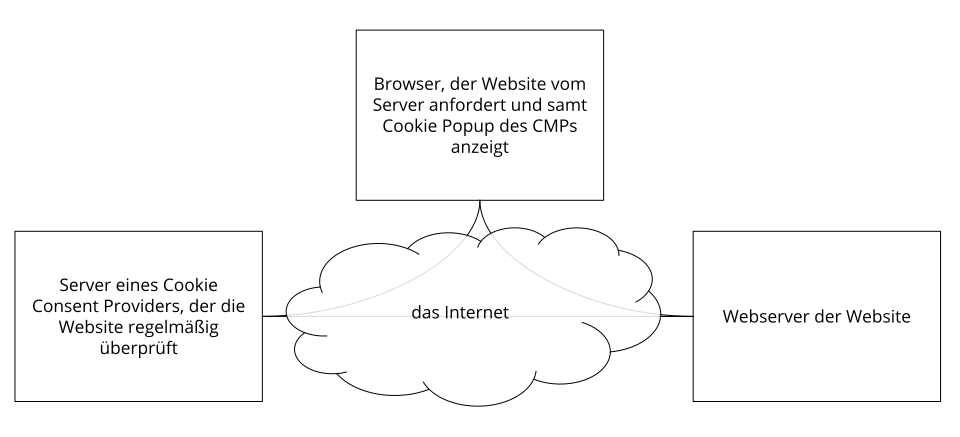
Why do we use a cookie management tool?
Our goal is to offer you the best possible transparency in the area of data protection. We are also legally obliged to do so. We want to inform you as well as possible about all tools and all cookies that can save and process your data. It is also your right to decide for yourself which cookies you accept and which you do not. In order to grant you this right, we first need to know exactly which cookies actually landed on our website. Thanks to a cookie management tool, which regularly scans the website for all cookies present, we know about all cookies and can provide you with GDPR-compliant information. You can then use the consent system to accept or reject cookies.
Which data are processed?
As part of our cookie management tool, you can manage each individual cookie yourself and have complete control over the storage and processing of your data. The declaration of your consent is stored so that we do not have to ask you every time you visit our website and we can also prove your consent if required by law. This is saved either in an opt-in cookie or on a server. The storage time of your cookie consent varies depending on the provider of the cookie management tool. Usually this data (e.g. pseudonymous user ID, time of consent, detailed information on the cookie categories or tools, browser, device information) is stored for up to two years.
Duration of data processing
We will inform you below about the duration of the data processing if we have further information. In general, we only process personal data for as long as is absolutely necessary for the provision of our services and products. Data stored in cookies are stored for different lengths of time. Some cookies are deleted after you leave the website, others may be stored in your browser for a few years. The exact duration of the data processing depends on the tool used, in most cases you should be prepared for a storage period of several years. In the respective data protection declarations of the individual providers, you will usually receive precise information about the duration of the data processing.
Right of objection
You also have the right and the option to revoke your consent to the use of cookies at any time. This works either via our cookie management tool or via other opt-out functions. For example, you can also prevent data collection by cookies by managing, deactivating or deleting cookies in your browser.
Information on special cookie management tools can be found – if available – in the following sections.
Legal basis
If you agree to cookies, your personal data will be processed and stored via these cookies. If we are allowed to use cookies with your consent (Article 6 paragraph 1 lit. a GDPR), this consent is also the legal basis for the use of cookies and the processing of your data. In order to be able to manage the consent to cookies and to enable you to give your consent, a cookie consent management platform software is used. The use of this software enables us to operate the website in an efficient and legally compliant manner, which is a legitimate interest (Article 6 paragraph 1 lit. f GDPR).
BorlabsCookie Privacy Policy
On our website we use BorlabsCookie, which is one of the tools that store your consent to cookies. The provider of this service is the German company Borlabs – Benjamin A. Bornschein, Rübenkamp 32, 22305 Hamburg, Germany. You can find out more about the data that is processed by the use of BorlabsCookie in their Privacy Policy at https://borlabs.io/privacy/.
Payment providers
| Payment Providers Privacy Policy Overview 👥 Affected parties: visitors to the website 🤝 Purpose: To enable and optimise the payment process on our website 📓 Processed data: data such as name, address, bank details (account number, credit card number, passwords, TANs, etc.), IP address and contract data You can find more details on this directly from the payment provider tool that is being used. 📅 Storage period: depending on the payment provider that is being used ⚖️ Legal basis: Art. 6 paragraph 1 lit. b GDPR (performance of a contract) |
What is a payment provider?
On our website we use online payment systems, which enable us as well as you to have a secure and smooth payment process available. Among other things, personal data may also be sent to the respective payment provider, where it may also be stored and processed. Payment providers are online payment systems that enable you to place an order via online banking. The payment processing is carried out by the payment provider of your choice. We will then receive information about the payment. This method can be used by any user who has an active online banking account with a PIN and TAN. There are hardly any banks that do not offer or accept such payment methods.
Why do we use payment providers on our website?
With both our website and our embedded online shop, we of course want to offer you the best possible service, so you can feel comfortable on our site and take advantage of our offers. We know that your time is valuable and that payment processing in particular has to work quickly and smoothly. Thus, we offer various payment providers. You can choose your preferred payment provider and pay in the usual way.
Which data are processed?
What exact data that is processed of course depends on the respective payment provider. However, generally data such as name, address, bank details (account number, credit card number, passwords, TANs, etc.) do get stored. This data is necessary for carrying out any transactions. In addition, any contract data and user data, such as when you have visited our website, what content you are interested in or which sub-pages you have clicked, may also be stored. Most payment providers also store your IP address and information about the computer you are using.
Your data is usually stored and processed on the payment providers’ servers. We, so the website operator, do not receive this data. We only get information on whether the payment has gone through or not. For identity and credit checks, it may happen for payment providers to forward data to the appropriate body. The business and privacy policy principles of the respective provider always apply to all payment transactions. Therefore, please always take a look at the general terms and conditions and the privacy policy of the payment provider. You e.g. also have the right to have data erased or rectified at any time. Please contact the respective service provider regarding your rights (right to withdraw, right of access and individual rights).
Duration of data processing
Provided we have further information on this, we will inform you below about the duration of the processing of your data. In general, we only process personal data for as long as is absolutely necessary for providing our services and products. This storage period may be exceeded however, if it is required by law, for example for accounting purposes. We keep any accounting documents of contracts (invoices, contract documents, account statements, etc.) for 10 years (Section 147 AO) and other relevant business documents for 6 years (Section 247 HGB).
Right to object
You always have the right to information, rectification and erasure of your personal data. If you have any questions, you can always contact the person that is responsible for the respective payment provider. You can find contact details for them either in our respective privacy policy or on the relevant payment provider’s website.
You can erase, deactivate or manage cookies in your browser, that payment providers use for their functions. How this works differs a little depending on which browser you are using. Please note, however, that the payment process may then no longer work.
Legal basis
For the processing of contractual or legal relationships (Art. 6 para. 1 lit. b GDPR), we offer other payment service providers in addition to the conventional banking/credit institutions. In the privacy policy of the individual payment providers (such as Amazon Payments, Apple Pay or Discover) you will find a detailed overview of data processing and data storage. In addition, you can always contact the responsible parties should you have any questions about data protection issues.
Provided it is available, you can find information on the special payment providers in the following sections.
eps-Überweisung Privacy Policy
On our website we use eps-Überweisung, which is a service for online payment methods. The provider of this service is the Austrian company Stuzza GmbH, Frankgasse 10/8, 1090 Vienna, Austria. You can find out more about the data that is processed by using eps-Überweisung in their privacy policy at https://eservice.stuzza.at/de/datenschutzerklaerung.html.
PayPal Privacy Policy
On our website we use the online payment service PayPal. The provider of this service is the American company PayPal Inc. The responsible entity for the European region is the company PayPal Europe (S.à r.l. et Cie, S.C.A., 22-24 Boulevard Royal, L-2449 Luxembourg).
PayPal also processes data in the USA, among other countries. We would like to note, that according to the European Court of Justice, there is currently no adequate level of protection for data transfers to the USA. This can be associated with various risks to the legality and security of data processing.
PayPal uses standard contractual clauses approved by the EU Commission as basis for data processing by recipients based in third countries (outside the European Union, Iceland, Liechtenstein, Norway and especially in the USA) or data transfer there (= Art. 46, paragraphs 2 and 3 of the GDPR). These clauses oblige PayPal to comply with the EU‘s level of data protection when processing relevant data outside the EU. These clauses are based on an implementing order by the EU Commission. You can find the order and the clauses here: https://ec.europa.eu/commission/presscorner/detail/en/ip_21_2847
You can find out more about the data processed by using PayPal in the Privacy Policy at https://https://www.paypal.com/webapps/mpp/ua/privacy-full.
Visa Privacy Policy
On our website we use Visa which is a global payment provider. The provider of this service is the American company Visa Inc. The responsible entity for the European region is the company Visa Europe Services Inc. (1 Sheldon Square, London W2 6TT, United Kingdom).
Visa also processes data in the USA, among other countries. We would like to note, that according to the European Court of Justice, there is currently no adequate level of protection for data transfers to the USA. This can be associated with various risks to the legality and security of data processing.
Visa uses standard contractual clauses approved by the EU Commission as basis for data processing by recipients based in third countries (outside the European Union, Iceland, Liechtenstein, Norway and especially in the USA) or data transfer there (= Art. 46, paragraphs 2 and 3 of the GDPR). These clauses oblige Visa to comply with the EU‘s level of data protection when processing relevant data outside the EU. These clauses are based on an implementing order by the EU Commission. You can find the order and the clauses here: https://ec.europa.eu/commission/presscorner/detail/en/ip_21_2847
You can find out more about the data processed through the use of Visa in the Privacy Policy at https://www.visa.co.uk/legal/privacy-policy.html.
Klarna Checkout Privacy Policy
| Klarna Checkout Privacy Policy Summary 👥 Affected parties: website visitors 🤝 Purpose: optimising the payment process on our website 📓 Processed data: data such as name, address, bank details (account number, credit card number, passwords, TANs, etc.), IP address and contract data You can find more details on this in the privacy policy below. 📅 Storage period: data is stored as long as Klarna needs it for processing. ⚖️ Legal bases: Art. 6 paragraph 1 lit. c GDPR (legal obligation), Art. 6 paragraph 1 lit. f GDPR (legitimate interests) |
What is Klarna Checkout?
On our website we use the Klarna Checkout online payment system by the Swedish company Klarna Bank AB. Klarna Bank is headquartered in Sveavägen 46, 111 34 Stockholm, Sweden. If you choose this service, your personal data will be sent to Klarna, where it will be stored and processed. With this privacy policy we want to give you an overview of Klarna’s data processing.
Klarna Checkout is a payment system for online shops. The user selects the payment method and Klarna Checkout takes over the entire payment process. Once a user has made payment via the checkout system and provided the relevant data, future online purchases can be made even faster and easier. Klarna’s system then recognises the existing customer after they enter their email address and postcode.
Why do we use Klarna Checkout on our website?
It is our goal to offer you the best possible service with our website and our integrated online shop. In addition to the overall website and offer experience this also includes smooth, fast and secure payment processing of your orders. To ensure this, we use the Klarna Checkout payment system.
What data is stored by Klarna Checkout?
As soon as you choose Klarna’s payment service and pay using Klarna Checkout, you transmit personal data to the company. On Klarna’s checkout page, technical data such as browser type, operating system, our web address, date and time, your IP address as well as your language and time zone settings are collected and transmitted to Klarna’s servers where they are stored. This data is stored even if you have not yet completed an order at that point.
If you order a product or service from our shop, you must enter your personal data in the provided fields. Klarna processes this data for handling the payment. The following personal data (along with general product information) may be stored and processed by Klarna to check your creditworthiness and identity:
- Contact information: Name, date of birth, national ID number, title, invoice- und shipping address, email address, telephone number, nationality or salary.
- Payment information such as credit cards or your account number
- Product details such as shipment number, as well as type and price of the product
Furthermore, there are data which may optionally be collected if you have specifically decided for it. These are for example political, religious, or ideological beliefs or various health data.
In addition to the data mentioned above, Klarna can also collect data about the goods or services you order. It may also do this via third parties (such as e.g. us or public databases). This can for example be the type or tracking number of the ordered article, but also information on your creditworthiness, as well as your income or loan grants. Klarna can also pass on your personal data to service companies such as software and data storage providers or us as a retailer.
Every time data is automatically filled into a form, cookies are involved. If you do not want to use this function, you can deactivate these cookies anytime. Below you will find instructions on how to delete, deactivate or manage cookies in your browser. Our tests have shown that Klarna does not directly place cookies. If you choose the payment method “Klarna Sofort” and click on “Order”, you will be redirected to the “Sofort” website. After successful payment you will land on our thank-you page. There the following cookie is set by sofort.com:
Name: SOFUEB
Value: e8cipp378mdscn9e17kajlfhv7111836018-4
Purpose: This cookie stores your session ID.
Expiry date: after ending the browser session
How long and where are the data stored?
Klarna strives to store your data only within the EU or the European Economic Area (EEA). However, it can also happen that data is transferred outside the EU/EEA. If this happens, Klarna ensures that the data protection either complies with the GDPR, that the third country is subject to an adequacy decision of the European Union or that the country has the US Privacy Shield certificate. Any data is always stored for as long as Klarna requires it for processing.
How can I erase my data or prevent data retention?
You can withdraw your consent for Klarna to process personal data anytime. Moreover, you always have the right for information, rectification, and deletion of your personal data. For this you must simply contact the company or its data protection team by email at privacy@klarna.co.uk. You can also contact them directly via “My Privacy Request” on Klarna’s website.
Cookies that Klarna may use for their functions can be deleted, deactivated, or managed in your browser. These settings can vary slightly, depending on the browser you use. The following instructions will show you how to manage cookies in your browser:
Chrome: Clear, enable and manage cookies in Chrome
Safari: Manage cookies and website data in Safari
Firefox: Clear cookies and site data in Firefox
Internet Explorer: Delete and manage cookies
Microsoft Edge: Delete cookies in Microsoft Edge
Legal basis
In addition to the conventional banking/credit institutions, we also offer the payment service provider Klarna Checkout for the processing of contractual or legal relationships (Art. 6 para. 1 lit. b GDPR).
We hope we were able to give you a good overview of Klarna’s data processing. If you want to learn more about the handling of your data, we recommend Klarna’s privacy notice at https://cdn.klarna.com/1.0/shared/content/legal/terms/0/en_gb/privacy.
Stripe Privacy Policy
| Stripe Privacy Policy Overview 👥 Affected parties: website visitors 🤝 Purpose: optimising the payment process on our website 📓 Processed data: data such as name, address, bank details (account number, credit card number, passwords, TANs, etc.), IP address and contract data You can find more details on this in the privacy policy below 📅 Storage period: data is stored until the collaboration with Stripe is terminated ⚖️ Legal basis: Art. 6 para. 1 lit. b GDPR (contract processing), Art. 6 para. 1 lit. a GDPR (consent) |
What is Stripe?
On our website we use a payment tool by Stripe, an American technology company and online payment service. Stripe Payments Europe (Europe Ltd., 1 Grand Canal Street Lower, Grand Canal Dock, Dublin, Ireland) is responsible for customers within the EU. Therefore, if you choose Stripe as your payment method, your payment will be processed via Stripe Payments. Hence, the data required for the payment process is forwarded to Stripe where it is then stored. In this privacy policy we will give you an overview of Stripe’s data processing and retention. Moreover, we will explain why we use Stripe on our website.
The technology company Stripe offers payment solutions for online payments. Stripe enables us to accept credit and debit card payments in our webshop while it handles the entire payment process. A major advantage of Stripe is that you never have to leave our website or shop during the payment process. Moreover, payments are processed very quickly via Stripe.
Why do we use Stripe on our website?
We of course want to offer the best possible service with both our website and our integrated online shop. After all, we would like you to feel comfortable on our site and take advantage of our offers. We know that your time is valuable and therefore, payment processing in particular must work quickly and smoothly. In addition to our other payment providers, with Stripe we have found a partner that guarantees secure and fast payment processing.
What data are stored by Stripe?
If you choose Stripe as your payment method, your personal data (transaction data) will be transmitted to Stripe where it will be stored. These data include the payment method (i.e. credit card, debit card or account number), bank sort code, currency, as well as the amount and the payment date. During a transaction, your name, email address, billing or shipping address and sometimes your transaction history may also be transmitted. These data are necessary for authentication. Furthermore, Stripe may also collect relevant data for the purpose of fraud prevention, financial reporting and for providing its services in full. These data may include your name, address, telephone number as well as your country in addition to technical data about your device (such as your IP address).
Stripe does not sell any of your data to independent third parties, such as marketing agencies or other companies that have nothing to do with Stripe. However, data may be forwarded to internal departments, a limited number of Stripe’s external partners or for legal compliance reasons. What is more, Stripe uses cookies to collect data. Here is a selection of cookies that Stripe may set during the payment process:
Name: m
Value: edd716e9-d28b-46f7-8a55-e05f1779e84e040456111836018-5
Purpose: This cookie appears when you select your payment method. It saves and recognises whether you are accessing our website via a PC, tablet or smartphone.
Expiry date: after 2 years
Name: __stripe_mid
Value: fc30f52c-b006-4722-af61-a7419a5b8819875de9111836018-1
Purpose: This cookie is required for carrying out credit card transactions. For this purpose, the cookie stores your session ID.
Expiry date: after one year
Name: __stripe_sid
Value: 6fee719a-c67c-4ed2-b583-6a9a50895b122753fe
Purpose: This cookie also stores your ID. Stripe uses it for the payment process on our website.
Expiry date: after end of the session
How long and where are the data stored?
Generally, personal data are stored for the duration of the provided service. This means that the data will be stored until we terminate our cooperation with Stripe. However, in order to meet legal and official obligations, Stripe may also store personal data for longer than the duration of the provided service. Furthermore, since Stripe is a global company, your data may be stored in any of the countries Stripe offers its services in. Therefore, your data may be stored outside your country, such as in the USA for example.
How can I erase my data or prevent data retention?
Please note that when you use this tool, your data may also be stored and processed outside the EU. Most third countries (including the USA) are not considered secure under current European data protection law. Data must not simply be transferred to, as well as stored and processed in insecure third countries, unless there are suitable guarantees (such as EU standard contractual clauses) between us and the respective non-European service provider.
You always reserve the right to information, correction and deletion of your personal data. Should you have any questions, you can contact the Stripe team at https://support.stripe.com/contact/email.
You can erase, deactivate or manage cookies in your browser that Stripe uses for its functions. This works differently depending on which browser you are using. Please note, however, that if you do so the payment process may no longer work. The following instructions will show you how to manage cookies in your browser:
Chrome: Clear, enable and manage cookies in Chrome
Safari: Manage cookies and website data in Safari
Firefox: Clear cookies and site data in Firefox
Internet Explorer: Delete and manage cookies
Microsoft Edge: Delete cookies in Microsoft Edge
Legal basis
For the processing of contractual or legal relationships (Art. 6 para. 1 lit. b GDPR), we offer the payment service provider Sofortüberweisung in addition to the conventional bank/credit institutions. Successful use of the service also requires your consent (Art. 6 para. 1 lit. a GDPR), provided the use of cookies is necessary for it.
Stripe also processes data in the USA, among other countries. We would like to note, that according to the European Court of Justice, there is currently no adequate level of protection for data transfers to the USA. This can be associated with various risks to the legality and security of data processing.
Stripe uses standard contractual clauses approved by the EU Commission as basis for data processing by recipients based in third countries (outside the European Union, Iceland, Liechtenstein, Norway and especially in the USA) or data transfer there (= Art. 46, paragraphs 2 and 3 of the GDPR). These clauses oblige Stripe to comply with the EU‘s level of data protection when processing relevant data outside the EU. These clauses are based on an implementing order by the EU Commission. You can find the order and the clauses here: https://ec.europa.eu/commission/presscorner/detail/en/ip_21_2847
We have now given you a general overview of Stripe’s data processing and retention. If you want more information, Stripe’s detailed privacy policy at https://stripe.com/at/privacy is a good source.
Sofortüberweisung Privacy Policy
| Sofortüberweisung Privacy Policy Overview 👥 Affected parties: website visitors 🤝 Purpose: to optimise the payment process on our website 📓 Processed data: data such as name, address, bank details (account number, credit card number, passwords, TANs, etc.), IP address and contract data More details can be found in the privacy policy below 📅 Storage period: data are stored within the legal retention period ⚖️ Legal bases: Art. 6 paragraph 1 lit. c GDPR (legal obligation), Art. 6 paragraph 1 lit. f GDPR (legitimate interests) |
What is “Sofortüberweisung”?
On our website we offer the payment method “Sofortüberweisung” from Sofort GmbH for cashless payment. Sofort GmbH has been part of the Swedish company Klarna since 2014, but is based in Germany, Theresienhöhe 12, 80339 Munich.
If you choose this payment method, your personal data will also be transmitted to Sofort GmbH or Klarna, where it will be stored and processed. In this privacy policy we will give you an overview of Sofort GmbH’s data processing.
Sofortüberweisung is an online payment system that enables you to place an order via online banking. The payment is processed by Sofort GmbH, while we immediately receive information about your payment. Anyone who has an active online banking account with a PIN and TAN can use this method. Only a few banks do not yet support this payment option.
Why do we use “Sofortüberweisung” on our website?
It is our goal to offer you the best possible service with our website and our integrated online shop. Next to the overall experience of the website and offers, this also includes smooth, fast, and secure payment processing of your orders. To ensure this, we use “Sofortüberweisung” as a payment system.
What data is stored by “Sofortüberweisung”?
If you make an immediate transfer via the Sofort/Klarna service, data such as your name, account number, sort code, payment reference, amount and date are stored on the company’s servers. We then also receive this information via the payment confirmation.
As part of the check for sufficient account coverage, Sofort GmbH reviews whether your account balance and overdraft can cover the payment amount. In some cases, it is also reviewed whether any instant transfers have been successfully carried out within the last 30 days. Furthermore, a shortened (“hashed”) form of your user identification (such as your signatory or contract number) as well as your IP address will be stored. For SEPA transfers your BIC and IBAN will also be stored.
According to Sofort GmbH, no other personal data (such as account balances, sales data, transaction limits, account lists, mobile phone numbers, authentication certificates, security codes or PIN/TAN) are collected, stored or passed on to third parties.
Sofortüberweisung also uses cookies to make our service more user-friendly. When you order a product, you will be redirected to the Sofort or Klarna website. After successful payment you will be redirected to our thank-you page. There, the following three cookies are placed:
Name: SOFUEB
Value: e8cipp378mdscn9e17kajlfhv7111836018-5
Purpose: This cookie stores your session ID.
Expiry date: after ending the browser session
Name: User[user_cookie_rules]
Value: 1
Purpose: This cookie stores the status of your consent to the use of cookies.
Expiry date: after 10 years
Name: _ga
Value: GA1.2.69759879.1589470706
Purpose: Analytics.js uses the _ga cookie by default to store your user ID. Hence, it basically serves to differentiate between website visitors. It is a Google Analytics cookie.
Expiry date: after 2 years
Note: We do not claim for this cookie list to be exhaustive. Moreover, it is always possible that Sofortüberweisung may also use other cookies.
How long and where are the data stored?
All gathered data are stored within the legal storage obligations. This obligation can last between three and ten years.
Klarna/Sofort GmbH try to only save data within the EU or the European Economic Area (EEA). If data is transferred outside the EU/EEA, data protection must comply with the GDPR. Also, the country the data is transferred to must be subject to the EU’s adequacy decision or have the US Privacy Shield certificate.
How can I delete my data or prevent data retention?
You can withdraw your consent for Klarna to process your personal data at any time. You also always have the right for information, rectification and deletion of your personal data. For this, you can simply email the company’s data protection team at privacy@klarna.co.uk.
In your browser, you can manage, delete, or deactivate Sofortüberweisung’s possible cookies. The settings vary a bit depending on what browser you use. The following instructions will show you how to manage cookies in the most common browsers:
Chrome: Clear, enable and manage cookies in Chrome
Safari: Manage cookies and website data in Safari
Firefox: Clear cookies and site data in Firefox
Internet Explorer: Delete and manage cookies
Microsoft Edge: Delete cookies in Microsoft Edge
Legal basis
For the processing of contractual or legal relationships (Art. 6 para. 1 lit. b GDPR), we offer the payment service provider Sofortüberweisung in addition to the conventional bank/credit institutions. Successful use of the service also requires your consent (Art. 6 para. 1 lit. a GDPR), provided the use of cookies is necessary.
If you want to know more about Sofort GmbH’s data processing, we recommend the privacy policy at https://cdn.klarna.com/1.0/shared/content/legal/terms/0/en_gb/privacy.
Social Media
| Social Media Privacy Policy Overview 👥 Affected parties: website visitors 🤝 Purpose: Service presentation and optimisation, staying in contact with visitors, interested parties, etc. as well as advertising 📓 Processed data: data such as telephone numbers, email addresses, contact data, data on user behaviour, information about your device and your IP address. You can find more details on this directly at the respective social media tool used. 📅 Storage period: depending on the social media platforms used ⚖️ Legal bases: Art. 6 para. 1 lit. a GDPR (consent), Art. 6 para. 1 lit. f GDPR (legitimate interests) |
What is Social Media?
In addition to our website, we are also active on various social media platforms. For us to be able to target interested users via social networks, user data may be processed. Additionally, elements of social media platforms may be embedded directly in our website. This is e.g. the case if you click a so-called social button on our website and are forwarded directly to our social media presence. So-called social media are websites and apps on which registered members can produce and exchange content with other members, be it openly or in certain groups and networks.
Why do we use Social Media?
For years, social media platforms have been the place where people communicate and get into contact online. With our social media presence, we can familiarise interested people better with our products and services. The social media elements integrated on our website help you switch to our social media content quickly and hassle free.
The data that is retained and processed when you use a social media channel is primarily used to conduct web analyses. The aim of these analyses is to be able to develop more precise and personal marketing and advertising strategies. The evaluated data on your behaviour on any social media platform can help to draw appropriate conclusions about your interests. Moreover, so-called user profiles can be created. Thus, the platforms may also to present you with customised advertisements. For this, cookies are usually placed in your browser, which store data on your user behaviour.
We generally assume that we will continue to be responsible under Data Protection Law, even when using the services of a social media platform. However, the European Court of Justice has ruled that, within the meaning of Art. 26 GDPR, in certain cases the operator of the social media platform can be jointly responsible with us. Should this be the case, we will point it out separately and work on the basis of a related agreement. You will then find the essence of the agreement for the concerned platform below.
Please note that when you use social media platforms or our built-in elements, your data may also be processed outside the European Union, as many social media channels, such as Facebook or Twitter, are American companies. As a result, you may no longer be able to easily claim or enforce your rights regarding your personal data.
Which data are processed?
Exactly which data are stored and processed depends on the respective provider of the social media platform. But usually it is data such as telephone numbers, email addresses, data you enter in contact forms, user data such as which buttons you click, what you like or who you follow, when you visited which pages, as well as information about your device and IP address. Most of this data is stored in cookies. Should you have a profile on the social media channel you are visiting and are logged in, data may be linked to your profile.
All data that are collected via social media platforms are also stored on the providers’ servers. This means that only the providers have access to the data and can provide you with appropriate information or make changes for you.
If you want to know exactly which data is stored and processed by social media providers and how you can object to the data processing, we recommend you to carefully read the privacy policy of the respective company. We also recommend you to contact the provider directly if you have any questions about data storage and data processing or if you want to assert any corresponding rights.
Duration of data processing
Provided we have any further information on this, we will inform you about the duration of the data processing below. The social media platform Facebook example stores data until they are no longer needed for the company’s own purposes. However, customer data that is synchronised with your own user data is erased within two days. Generally, we only process personal data for as long as is absolutely necessary for the provision of our services and products. This storage period can also be exceeded however, if it is required by law, such as e.g. in the case of accounting.
Right to object
You also retain the right and the option to revoke your consent to the use of cookies or third-party providers such as embedded social media elements at any time. This can be done either via our cookie management tool or via other opt-out functions. You can e.g. also prevent data collection via cookies by managing, deactivating or erasing cookies in your browser.
Since cookies may be used with social media tools, we also recommend you to read our privacy policy on cookies. If you want to find out which of your data is stored and processed, we advise you to read the privacy policies of the respective tools.
Legal basis
If you have consented to the processing and storage of your data by integrated social media elements, this consent serves as the legal basis for data processing (Art. 6 para. 1 lit. a GDPR). Generally, provided you have given your consent, your data will also be stored and processed on the basis of our legitimate interest (Art. 6 para. 1 lit. f GDPR) in maintaining fast and good communication with you and other customers and business partners. Nevertheless, we only use the tools if you have consented. Most social media platforms also set cookies on your browser to store data. We therefore recommend you to read our privacy policy on cookies carefully and to take a look at the privacy policy or cookie policy of the respective service provider.
in the following section you can find information on special social media platforms – provided this information is available.
Facebook Privacy Policy
| Facebook Privacy Policy Overview 👥 Affected parties: website visitors 🤝 Purpose: service optimisation 📓 Processed data: data such as customer data, data on user behaviour, device information and IP address. You can find more details in the Privacy Policy below. 📅 Storage period: until the data no longer serves Facebook’s purposes ⚖️ Legal bases: Art. 6 para. 1 lit. a GDPR (consent), Art. 6 para. 1 lit. f GDPR (legitimate interests) |
What are Facebook tools?
We use selected Facebook tools on our website. Facebook is a social media network of the company Facebook Ireland Ltd., 4 Grand Canal Square, Grand Canal Harbour, Dublin 2 Ireland. With the aid of this tool we can provide the best possible offers to you and anyone interested in our products and services.
If your data is collected and forwarded via our embedded Facebook elements or via our Facebook page (fanpage), both we and Facebook Ireland Ltd. are responsible for this. However, should any further processing occur, then Facebook is solely responsible for this data. Our joint commitments were also set out in a publicly available agreement at https://www.facebook. com / legal / controller_addendum . It e.g. states that we must clearly inform you about the use of Facebook tools on our website. We are also responsible for ensuring that the tools are securely integrated into our website and are in accordance with the applicable privacy laws. Facebook, on the other hand, is e.g. responsible for the data security of Facebook’s products. If you have any questions about Facebook’s data collection and processing, you can contact the company directly. Should you direct the question to us, we are obliged to forward it to Facebook.
In the following we will give you an overview on the different Facebook tools, as well as on what data is sent to Facebook and how you can erase this data.
Along with many other products, Facebook also offers so called “Facebook Business Tools”. This is Facebook’s official name for its tools, but it is not very common. Therefore, we decided to merely call them “Facebook tools”. They include the following:
- Facebook-Pixel
- Social Plugins (e.g. the “Like” or “Share“ button)
- Facebook Login
- Account Kit
- APIs (application programming interface)
- SDKs (Softwart developmept kits)
- Plattform-integrations
- Plugins
- Codes
- Specifications
- Documentations
- Technologies and Services
With these tools Facebook can extend its services and is able to receive information on user activities outside of Facebook.
Why do we use Facebook tools on our website?
We only want to show our services and products to people who are genuinely interested in them. With the help of advertisements (Facebook Ads) we can reach exactly these people. However, to be able to show suitable adverts to users, Facebook requires additional information on people’s needs and wishes. Therefore, information on the user behaviour (and contact details) on our website, are provided to Facebook. Consequently, Facebook can collect better user data and is able to display suitable adverts for our products or services. Thanks to the tools it is possible to create targeted, customised ad campaigns of Facebook.
Facebook calls data about your behaviour on our website “event data” and uses them for analytics services. That way, Facebook can create “campaign reports” about our ad campaigns’ effectiveness on our behalf. Moreover, by analyses we can get a better insight in how you use our services, our website or our products. Therefore, some of these tools help us optimise your user experience on our website. With the social plugins for instance, you can share our site’s contents directly on Facebook.
What data is stored by Facebook tools?
With the use of Facebook tools, personal data (customer data) may be sent to Facebook. Depending on the tools used, customer data such as name, address, telephone number and IP address may be transmitted.
Facebook uses this information to match the data with the data it has on you (if you are a Facebook member). However, before the customer data is transferred to Facebook, a so called “Hashing” takes place. This means, that a data record of any size is transformed into a string of characters, which also has the purpose of encrypting data.
Moreover, not only contact data, but also “event data“ is transferred. These data are the information we receive about you on our website. To give an example, it allows us to see what subpages you visit or what products you buy from us. Facebook does not disclose the obtained information to third parties (such as advertisers), unless the company has an explicit permission or is legally obliged to do so. Also, “event data“ can be linked to contact information, which helps Facebook to offer improved, customised adverts. Finally, after the previously mentioned matching process, Facebook deletes the contact data.
To deliver optimised advertisements, Facebook only uses event data, if they have been combined with other data (that have been collected by Facebook in other ways). Facebook also uses event data for the purposes of security, protection, development and research. Many of these data are transmitted to Facebook via cookies. Cookies are little text files, that are used for storing data or information in browsers. Depending on the tools used, and on whether you are a Facebook member, a different number of cookies are placed in your browser. In the descriptions of the individual Facebook tools we will go into more detail on Facebook cookies. You can also find general information about the use of Facebook cookies at https://www.facebook.com/policies/cookies.
How long and where are the data stored?
Facebook fundamentally stores data, until they are no longer of use for their own services and products. Facebook has servers for storing their data all around the world. However, customer data is cleared within 48 hours after they have been matched with their own user data.
How can I erase my data or prevent data retention?
In accordance with the General Data Protection Regulation (GDPR) you have the right of information, rectification, transfer and deletion of your data.
The collected data is only fully deleted, when you delete your entire Facebook account. Deleting your Facebook account works as follows:
1) Click on settings in the top right side in Facebook.
2) Then, click “Your Facebook information“ in the left column.
3) Now click on “Deactivation and deletion”.
4) Choose “Permanently delete account“ and then click on “Continue to account deletion“.
5) Enter your password, click on “continue“ and then on “Delete account“.
The retention of data Facebook receives via our site is done via cookies (e.g. with social plugins), among others. You can deactivate, clear or manage both all and individual cookies in your browser. How this can be done differs depending on the browser you use. The following instructions show, how to manage cookies in your browser:
Chrome: Clear, enable and manage cookies in Chrome
Safari: Manage cookies and website data in Safari
Firefox: Clear cookies and site data in Firefox
Internet Explorer: Delete and manage cookies
Microsoft Edge: Delete cookies in Microsoft Edge
If you generally do not want to allow any cookies at all, you can set up your browser to notify you whenever a cookie is about to be set. This gives you the opportunity to decide upon the permission or deletion of every single cookie.
Legal basis
If you have consented to your data being processed and stored by integrated Facebook tools, this consent is the legal basis for data processing (Art. 6 para. 1 lit. a GDPR). Generally, your data is also stored and processed on the basis of our legitimate interest (Art. 6 para. 1 lit. f GDPR) to maintain fast and good communication with you or other customers and business partners. Nevertheless, we only use these tools if you have given your consent. Most social media platforms also set cookies on your browser to store data. We therefore recommend you to read our privacy policy about cookies carefully and to take a look at the privacy policy or Facebook’s cookie policy.
Facebook also processes data in the USA, among other countries. We would like to note, that according to the European Court of Justice, there is currently no adequate level of protection for data transfers to the USA. This can be associated with various risks to the legality and security of data processing.
Facebook uses standard contractual clauses approved by the EU Commission as basis for data processing by recipients based in third countries (outside the European Union, Iceland, Liechtenstein, Norway and especially in the USA) or data transfer there (= Art. 46, paragraphs 2 and 3 of the GDPR). These clauses oblige Facebook to comply with the EU‘s level of data protection when processing relevant data outside the EU. These clauses are based on an implementing order by the EU Commission. You can find the order and the clauses here: https://ec.europa.eu/commission/presscorner/detail/en/ip_21_2847
We hope we could give you an understanding of the most important information about the use of Facebook tools and data processing. If you want to find out more on how Facebook use your data, we recommend reading the data policies at https://www.facebook.com/about/privacy/update.
Facebook Social Plugins Privacy Policy
We installed so-called social plugins from Facebook Inc. to our website. You can recognise these buttons by the classic Facebook logo, the “Like” button (hand with raised thumb) or by a “Facebook plugin” label. A social plugin is a small part of Facebook that is integrated into our page. Each plugin has its own function. The most used functions are the well-known “Like” and “Share” buttons.
Facebook offers the following social plugins:
- “Save” button
- “Like” button, Share, Send and Quote
- Page plugin
- Comments
- Messenger plugin
- Embedded posts and video player
- Group Plugin
At https://developers.facebook.com/docs/plugins you will find more information on how the individual plugins are used. On the one hand, we use the social plug-ins to offer you a better user experience on our site, and on the other hand because Facebook can optimise our advertisements with it.
If you have a Facebook account or have already visited facebook.com, Facebook has already placed at least one cookie in your browser. In this case, your browser sends information to Facebook via this cookie as soon as you visit our website or interact with social plugins (e.g. the “Like” button).
The received information will be deleted or anonymised within 90 days. According to Facebook, this data includes your IP address, the websites you have visited, the date, time and other information relating to your browser.
In order to prevent Facebook from collecting much data and matching it with your Facebook data during your visit to our website, you must log out of Facebook while you visit our website.
If you are not logged in to Facebook or do not have a Facebook account, your browser sends less information to Facebook because you have fewer Facebook cookies. Nevertheless, data such as your IP address or which website you are visiting can be transmitted to Facebook. We would like to explicitly point out that we do not know what exact data is collected. However, based on our current knowledge, we want to try informing you as best we can about data processing. You can also read about how Facebook uses the data in the company’s data policy at https://www.facebook.com/about/privacy/update.
At least the following cookies are set in your browser when you visit a website with social plugins from Facebook:
Name: dpr
Value: no information
Purpose:This cookie is used to make the social plugins work on our website.
Expiry date: after end of session
Name: fr
Value: 0jieyh4111836018c2GnlufEJ9..Bde09j…1.0.Bde09j
Purpose:The cookie is also necessary for the plugins to function properly
Expiry date: after 3 months
Note: These cookies were set after our test and may be placed even if you are not a Facebook member.
If you are registered with Facebook, you can change your settings for advertisements yourself at https://www.facebook.com/ads/preferences/?entry_product=ad_settings_screen. If you are not a Facebook user, you can go to https://www.youronlinechoices.com/uk/your-ad-choices/ and manage your usage-based online advertising. There you have the option to deactivate or activate providers.
If you want to learn more about Facebook’s data protection, we recommend the company’s own data policies at https://www.facebook.com/policy.php.
Facebook Login Privacy Policy
We integrated the convenient Facebook Login to our website. With it, you can easily log into our site with your Facebook account, without having to create a new user account. If you decide to register via the Facebook Login, you will be redirected to the social media network Facebook. There, you can log in with your Facebook user data. By using this method to log in, data on you and your user behaviour is stored and transmitted to Facebook.
To save the data, Facebook uses various cookies. In the following we will show you the most significant cookies that are placed in your browser or that already exist when you log into our site via the Facebook Login:
Name: fr
Value: 0jieyh4c2GnlufEJ9..Bde09j…1.0.Bde09j
Purpose: This cookie is used to make the social plugin function optimally on our website.
Expiry date: after 3 months
Name: datr
Value: 4Jh7XUA2111836018SEmPsSfzCOO4JFFl
Purpose: Facebook sets the “datr” cookie, when a web browser accesses facebook.com. The cookie helps to identify login activities and protect users.
Expiry date: after 2 years
Name: _js_datr
Value: deleted
Purpose: Facebook sets this session cookie for tracking purposes, even if you do not have a Facebook account or are logged out.
Expiry date: after the end of the session
Note: The cookies we stated are only a small range of the cookies which are available to Facebook. Other cookies include for example _ fbp, sb or wd. It is not possible to disclose an exhaustive list, since Facebook have a multitude of cookies at their disposal which they use in variation.
On the one hand, Facebook Login enables a fast and easy registration process. On the other hand, it gives us the opportunity to share data with Facebook. In turn, we can customise our offer and advertising campaigns better to your needs and interests. The data we receive from Facebook by this means, is public data such as
- your Facebook name
- your profile picture
- your stored email address
- friends lists
- button clicks (e.g. “Like“ button)
- date of birth
- language
- place of residence
In return, we provide Facebook with information about your activities on our website. These include information on the terminal device you used, which of our subpages you visit, or what products you have bought from us.
By using Facebook Login, you agree to the data processing. You can terminate this agreement anytime. If you want to learn more about Facebook’s data processing, we recommend you to read Facebook’s Data Policy at https://www.facebook.com/policy.php.
If you are registered with Facebook, you can change your advertisement settings anytime at https://www.facebook.com/ads/preferences/?entry_product=ad_settings_screen.
Instagram Privacy Policy
| Instagram Privacy Policy Overview 👥 Affected parties: website visitors 🤝 Purpose: optimising our service 📓 Processed data: includes data on user behaviour, information about your device and IP address. More details can be found in the privacy policy below. 📅 Storage period: until Instagram no longer needs the data for its purposes ⚖️ Legal basis: Art. 6 para. 1 lit. a GDPR (consent), Art. 6 para. 1 lit. f GDPR (legitimate interests) |
What is Instagram?
We have integrated functions of Instagram to our website. Instagram is a social media platform of the company Instagram LLC, 1601 Willow Rd, Menlo Park CA 94025, USA. Since 2012, Instagram is a subsidiary company of Facebook Inc. and is a part of Facebook’s products. The inclusion of Instagram’s contents on our website is called embedding. With this, we can show you Instagram contents such as buttons, photos or videos directly on our website. If you open websites of our online presence, that have an integrated Instagram function, data gets transmitted to, as well as stored and processed by Instagram. Instagram uses the same systems and technologies as Facebook. Therefore, your data will be processed across all Facebook firms.
In the following, we want to give you a more detailed insight on why Instagram collects data, what data these are and how you can control data processing. As Instagram belongs to Facebook Inc., we have, on the one hand received this information from the Instagram guidelines, and on the other hand from Facebook’s Data Policy.
Instagram is one of the most famous social media networks worldwide. Instagram combines the benefits of a blog with the benefits of audio-visual platforms such as YouTube or Vimeo. To “Insta“ (how the platform is casually called by many users) you can upload photos and short videos, edit them with different filters and also share them to other social networks. Also, if you do not want to be active on Instagram yourself, you can just follow other interesting users.
Why do we use Instagram on our website?
Instagram is a social media platform whose success has skyrocketed within recent years. Naturally, we have also reacted to this boom. We want you to feel as comfortable as possible on our website. Therefore, we attach great importance to diversified contents. With the embedded Instagram features we can enrich our content with helpful, funny or exciting Instagram contents. Since Instagram is a subsidiary company of Facebook, the collected data can also serve us for customised advertising on Facebook. Hence, only persons who are genuinely interested in our products or services can see our ads.
Instagram also uses the collected data for tracking and analysis purposes. We receive summarised statistics and therefore more insight to your wishes and interests. It is important to mention that these reports do not identify you personally.
What data is stored by Instagram?
Whenever you land on one of our sites, which have Instagram functions (i.e. Instagram photos or plugins) integrated to them, your browser automatically connects with Instagram’s servers. Thereby, data is sent to, as well as saved and processed by Instagram. This always happens, whether you have an Instagram account or not. Moreover, it includes information on our website, your computer, your purchases, the advertisements you see and on how you use our offer. The date and time of your interaction is also stored. If you have an Instagram account or are logged in, Instagram saves significantly more data on you.
Facebook distinguishes between customer data and event data. We assume this is also the case for Instagram. Customer data are for example names, addresses, phone numbers and IP addresses. These data are only transmitted to Instagram, if they have been “hashed” first. Thereby, a set of data is transformed into a string of characters, which encrypts any contact data. Moreover, the aforementioned “event data“ (data on your user behaviour) is transmitted as well. It is also possible, that contact data may get combined with event data. The collected data data is matched with any data Instagram already has on you.
Furthermore, the gathered data are transferred to Facebook via little text files (cookies) which usually get set in your browser. Depending on the Instagram function used, and whether you have an Instagram account yourself, the amount of data that gets stored varies.
We assume data processing on Instagram works the same way as on Facebook. Therefore, if you have an account on Instagram or have visited www.instagram.com, Instagram has set at least one cookie. If this is the case, your browser uses the cookie to send information to Instagram, as soon as you come across an Instagram function. No later than 90 days (after matching) the data is deleted or anonymised. Even though we have studied Instagram’s data processing in-depth, we cannot tell for sure what exact data Instagram collects and retains.
In the following we will show you a list of the least cookies placed in your browser when click on an Instagram function (e.g. button or an Insta picture). In our test we assume you do not have an Instagram account, since if you would be logged in to your Instagram account, your browser would place significantly more cookies.
The following cookies were used in our test:
Name: csrftoken
Value: “”
Purpose: This cookie is most likely set for security reasons to prevent falsifications of requests. We could not find out more information on it.
Expiry date: after one year
Name: mid
Value: “”
Purpose: Instagram places this cookie to optimise its own offers and services in- and outside of Instagram. The cookie allocates a unique user ID.
Expiry date: after end of session
Name: fbsr_111836018124024
Value: no information
Purpose: This cookie stores the login request of Instagram app users.
Expiry date: after end of session
Name: rur
Value: ATN
Purpose: This is an Instagram cookie which guarantees functionality on Instagram.
Expiry date: after end of session
Name: urlgen
Value: “{”194.96.75.33”: 1901}:1iEtYv:Y833k2_UjKvXgYe111836018”
Purpose: This cookie serves Instagram’s marketing purposes.
Expiry date: after end of session
Note: We do not claim this list to be exhaustive. The cookies that are placed in each individual case, depend on the functions embedded as well as on your use of Instagram.
How long and where are these data stored?
Instagram shares the information obtained within the Facebook businesses with external partners and persons you are globally connected with. Data processing is done according to Facebook’s internal data policy. Your data is distributed to Facebook’s servers across the world, partially for security reasons. Most of these servers are in the USA.
How can I erase my data or prevent data retention?
Thanks to the General Data Protection Regulation (GDPR), you have the right of information, rectification, transfer and deletion of your data. Furthermore, you can manage your data in Instagram’s settings. If you want to delete your data on Instagram completely, you will have to delete your Instagram account permanently.
And this is how an Instagram account can be deleted:
First, open the Instagram app. Then, navigate to your profile page, select the three bars in the top right, choose “Settings” and then click “Help”. Now, you will be redirected to the company’s website, where you must click on “Managing Your Account” and then “Delete Your Account”.
When you delete your account completely, Instagram deletes posts such as your photos and status updates. Any information other people shared about you are not a part of your account and do therefore not get deleted.
As mentioned before, Instagram primarily stores your data via cookies. You can manage, deactivate or delete these cookies in your browser. Depending on your browser, managing them varies a bit. We will show you the instructions of the most relevant browsers here.
Chrome: Clear, enable and manage cookies in Chrome
Safari: Manage cookies and website data in Safari
Firefox: Clear cookies and site data in Firefox
Internet Explorer: Delete and manage cookies
Microsoft Edge: Delete cookies in Microsoft Edge
Generally, you can set your browser to notify you whenever a cookie is about to be set. Then you can individually decide upon the permission of every cookie.
Legal basis
If you have consented to the processing and storage of your data by integrated social media elements, this consent is the legal basis for data processing (Art. 6 para. 1 lit. a GDPR) . Generally, your data is also stored and processed on the basis of our legitimate interest (Art. 6 para. 1 lit. f GDPR) to maintain fast and good communication with you or other customers and business partners. We only use the integrated social media elements if you have given your consent. Most social media platforms also place cookies in your browser to store data. We therefore recommend you to read our privacy policy about cookies carefully and to take a look at the privacy policy or the cookie policy of the respective service provider.
Instagram and Facebook also process data in the USA, among other countries. We would like to note, that according to the European Court of Justice, there is currently no adequate level of protection for data transfer to the USA. This can be associated with various risks to the legality and security of data processing.
As a basis for data processing by recipients based in third countries (outside the European Union, Iceland, Liechtenstein, Norway and especially in the USA) or data transfers there, Facebook uses standard contractual clauses approved by the EU Commission (= Art. 46, paragraphs 2 and 3 of the GDPR). These clauses oblige Facebook to comply with the EU’s level of data protection when processing relevant data outside the EU. These clauses are based on an implementing order by the EU Commission. You can find the order and the clauses here: https://ec.europa.eu/commission/presscorner/detail/en/ip_21_2847
We have tried to give you the most important information about data processing by Instagram. On https://help.instagram.com/519522125107875
you can take a closer look at Instagram’s data guidelines.
YouTube Privacy Policy
| YouTube Privacy Policy Overview 👥 Affected parties: website visitors 🤝 Purpose: optimising our service 📓 Processed data: Data such as contact details, data on user behaviour, information about your device and IP address may be stored. You can find more details on this in the privacy policy below. 📅 Storage period: data are generally stored for as long as is necessary for the purpose of the service ⚖️ Legal bases: Art. 6 para. 1 lit. a GDPR (consent), Art. 6 para. 1 lit. f GDPR (legitimate interests) |
What is YouTube?
We have integrated YouTube videos to our website. Therefore, we can show you interesting videos directly on our site. YouTube is a video portal, which has been a subsidiary company of Google LLC since 2006. The video portal is operated by YouTube, LLC, 901 Cherry Ave., San Bruno, CA 94066, USA. When you visit a page on our website that contains an embedded YouTube video, your browser automatically connects to the servers of YouTube or Google. Thereby, certain data are transferred (depending on the settings). Google is responsible for YouTube’s data processing and therefore Google’s data protection applies.
In the following we will explain in more detail which data is processed, why we have integrated YouTube videos and how you can manage or clear your data.
On YouTube, users can watch, rate, comment or upload videos for free. Over the past few years, YouTube has become one of the most important social media channels worldwide. For us to be able to display videos on our website, YouTube provides a code snippet that we have integrated to our website.
Why do we use YouTube videos on our website?
YouTube is the video platform with the most visitors and best content. We strive to offer you the best possible user experience on our website, which of course includes interesting videos. With the help of our embedded videos, we can provide you other helpful content in addition to our texts and images. Additionally, embedded videos make it easier for our website to be found on the Google search engine. Moreover, if we place ads via Google Ads, Google only shows these ads to people who are interested in our offers, thanks to the collected data.
What data is stored by YouTube?
As [Truncated]

